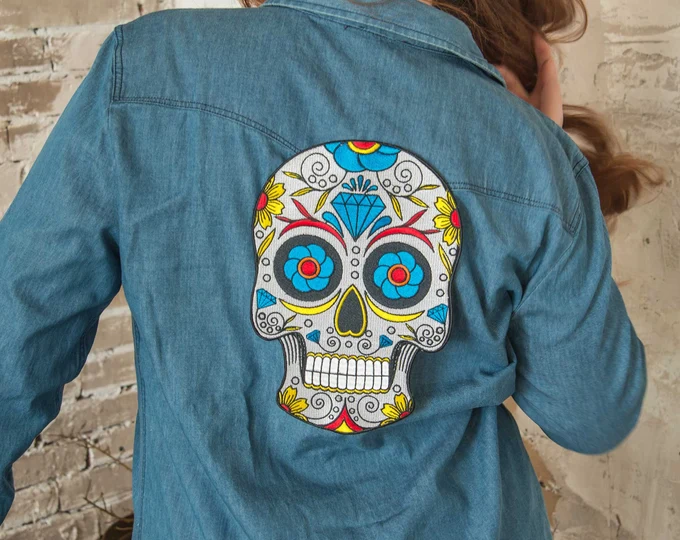
Few symbols carry as much attitude like a skull, and not many accessories let that attitude show off quite as well as a big patch on the back of a jacket. From biker culture to metal fashion to more modern streetwear, oversized skull patches have carved out a permanent spot in how people express defiance, identity and personal style, through clothing. Still, behind the loud visual appeal there is this kind of quiet nuance in materials sizing, and placement— details that make the difference between a patch that looks sharp for years and one that starts to peel, or fade within a season.
Why Skulls , an why so big ?
Skull imagery has always been tied to defiance , mortality , a kind of liberty , and nonconformity, and that stuff hits hard in biker communities , rock and metal subcultures, and even streetwear circles. A tiny patch might suggest the whole vibe, but when it’s a huge back patch , it turns into a statement thing, you know. Back patches , sometimes called back panels, take over the back of a jacket or vest, and suddenly an ordinary garment feels unmistakably personal.
That’s really part of why oversized skull designs keep showing up for decades after they first appeared in biker fashion: they’re not subtle, and they are definitely not trying to be. A big patch grabs attention in a way a small emblem can’t, not even close.
Material Choices they really Shape the Final Look
Not every skull patch gets made the same way, and the material sitting underneath the idea has a big say in how it looks, and how long it lasts too.
Embroidered patches are still the most common pick for skull designs, mostly because the stitching is raised and textured. That kind of depth makes the artwork feel tactile and kind of classic. In most cases they stay solid through years of wear, which is why you see them a lot on leather jackets and biker vests, honestly they just fit.
PVC patches give you another vibe, more like a smooth rubber-like 3D molded surface. They’re really tough against water, weather, and day to day scuffs, so they often work well for riders and outdoor people. You know the kind, they need something that can handle rain, sun, and rough conditions without slowly getting worse.
Printed or woven patches usually make the most sense when the design has lots of tiny detail, gradients, or intricate shading. Embroidery thread can miss some of that sometimes, so these styles help keep the lines cleaner. They also tend to look flatter, which is better for more graphic layouts or photorealistic skull artwork.
So really, the decision comes down to what you care about most: embroidery for texture and tradition, PVC for weatherproof durability, and printed or woven styles for fine detail and sharper finishes.
Sizing and Placement Matter More Than People Expect
Because skull back patches are meant to be a focal point, sizing needs to match the jacket itself. A patch that’s too small can look lost on a large leather jacket back panel, while one that’s too large can overwhelm smaller garments or interfere with seams and pockets. Many buyers underestimate how much visual impact proper proportion has — a well-sized back patch looks intentional and bold, while a mismatched one can look like an afterthought.
Placement also plays a role beyond aesthetics. Back patches are typically centered between the shoulder blades, while smaller skull patches are often placed on sleeves, chest panels, or lapels for a subtler nod to the same style.
Attachment: Sew-On vs. Iron-On for Heavy Garments
Because large skull patches are frequently applied to thick materials like leather and heavy denim, attachment method becomes an important practical consideration.
Sew-on application remains the most reliable choice for large, heavy patches, since stitching distributes stress evenly and holds up to years of movement, weather, and washing. Iron-on backing, while convenient and fast, can struggle to bond as strongly with thick or coated fabrics like leather, and may loosen over time without reinforcement.
For jackets that see regular use — daily wear, motorcycle riding, or outdoor conditions — many patch wearers combine both methods: an iron-on bond for initial placement, followed by stitching around the edges for long-term security. This hybrid approach tends to outperform either method alone, especially for back patches that endure constant movement and friction.
A Note on Club Insignia and Authenticity
It’s worth mentioning that not all skull-style patches are free for anyone to wear. Motorcycle clubs often have protected insignia and back-patch designs reserved specifically for members, and wearing unauthorized club symbols can carry social or even legal consequences within biker communities. Anyone drawn to the aesthetic without club affiliation should look for original artwork or generic skull designs that don’t imitate a specific club’s protected imagery — plenty of striking, non-affiliated designs exist that capture the same rebellious spirit without stepping on established club identities.
Pre-Made vs. Custom Designs
Buyers generally choose between two paths: ready-made skull patches, which are mass-produced, affordable, and immediately available, or fully custom designs, which allow control over size, color palette, material, and artwork. Custom options tend to appeal most to motorcycle clubs, fashion brands, and individuals who want a design that isn’t shared by thousands of other jackets. Pre-made patches, meanwhile, offer convenience and lower cost for casual wearers who just want the aesthetic without a design process.
For those exploring their options in more depth — including sizing recommendations, material comparisons, and application techniques — a detailed resource on large skull patches for jackets covers the full range of styles and buying considerations.
Final Thoughts
A skull patch is rarely just decoration — it’s a statement about identity, style, and often a sense of belonging to a particular subculture. Getting it right means thinking beyond the artwork alone: choosing the right material for durability, sizing it appropriately for the garment, and using an attachment method built to last. For riders, rock fans, and streetwear enthusiasts alike, a well-made biker patch can turn a plain jacket into a lasting piece of personal expression.