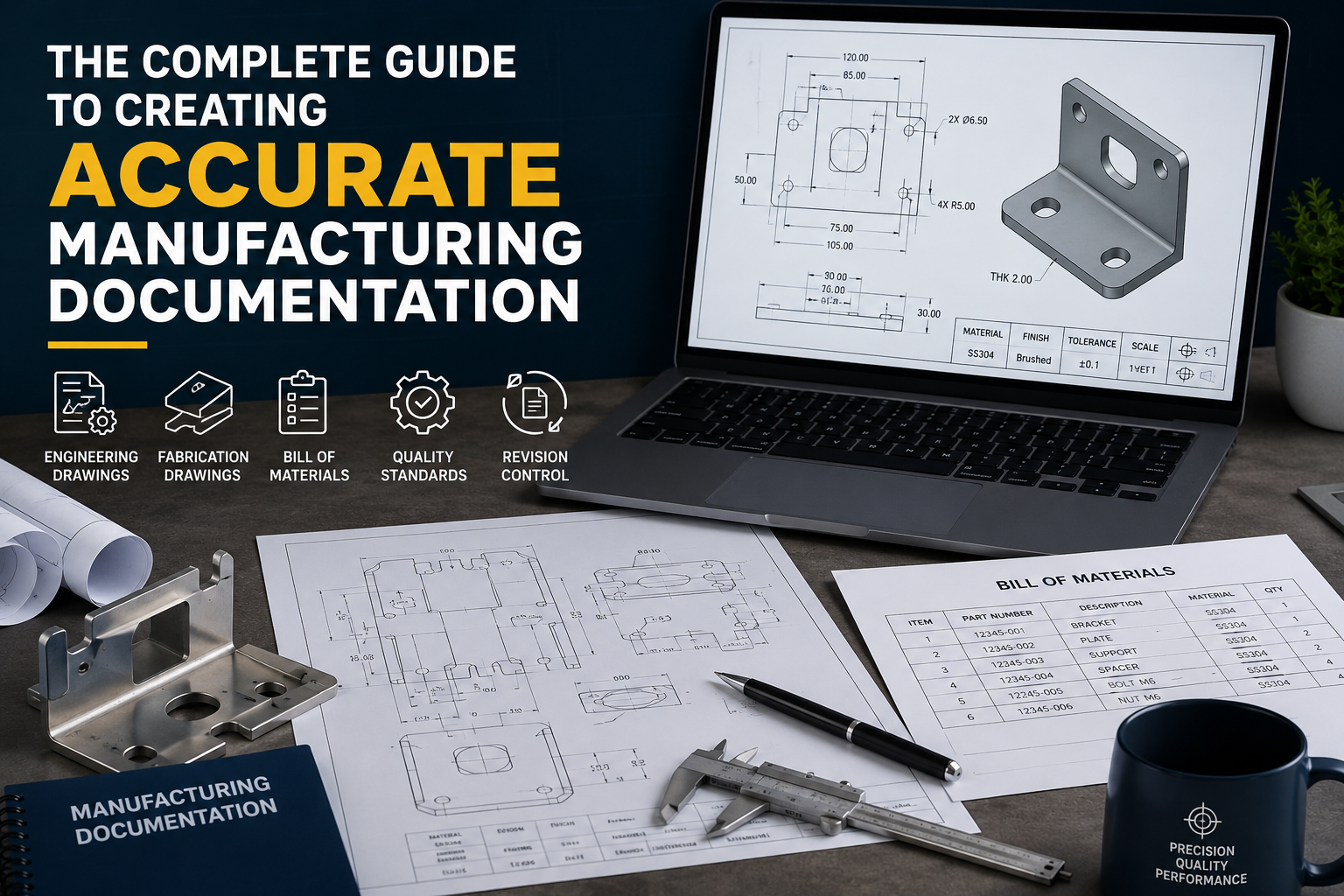
Manufacturing documentation is the foundation of every successful production process. Whether you’re producing sheet metal parts, machined components, or complex assemblies, clear and accurate documentation ensures that every stakeholder—from designers and engineers to manufacturers and quality inspectors—works from the same set of instructions.
Poor documentation often leads to production delays, costly errors, material waste, and communication gaps. On the other hand, well-prepared manufacturing documentation improves efficiency, product quality, and customer satisfaction.
In this guide, we’ll explore the essential components of manufacturing documentation, best practices for creating it, and how professional fabrication drawing services help manufacturers maintain precision throughout the production lifecycle.
What Is Manufacturing Documentation?
Manufacturing documentation is a collection of technical documents that communicate every detail required to manufacture, inspect, assemble, and maintain a product. These documents eliminate ambiguity by providing standardized instructions and engineering specifications.
Typical manufacturing documentation includes:
- Engineering drawings
- Fabrication drawings
- Assembly drawings
- Bills of Materials (BOM)
- Standard Operating Procedures (SOPs)
- Inspection reports
- Quality control documents
- CAD models
- Material specifications
- Revision history
Together, these documents ensure consistency from product design through final production.
Why Accurate Manufacturing Documentation Matters
1. Reduces Manufacturing Errors
One incorrect dimension or missing tolerance can result in defective parts and expensive rework. Accurate documentation minimizes production mistakes by providing clear manufacturing instructions.
2. Improves Communication
Manufacturing often involves multiple departments, suppliers, and subcontractors. Standardized documentation creates a common language that everyone understands.
3. Ensures Product Quality
Detailed inspection criteria and manufacturing specifications help quality teams verify that every part meets design requirements before shipment.
4. Supports Regulatory Compliance
Industries such as aerospace, automotive, medical devices, and industrial manufacturing require detailed documentation to comply with industry standards and customer requirements.
5. Simplifies Future Modifications
Well-maintained documentation allows engineers to update designs efficiently without recreating drawings from scratch.
Essential Components of Accurate Manufacturing Documentation
Engineering Drawings
Engineering drawings define the geometry, dimensions, tolerances, materials, surface finishes, and manufacturing requirements of each component.
A complete drawing typically includes:
- Dimensions
- Geometric Dimensioning and Tolerancing (GD&T)
- Material specifications
- Surface finish requirements
- Notes and symbols
- Revision information
Fabrication Drawings
Fabrication drawings provide production-ready information specifically for manufacturing processes such as cutting, bending, welding, punching, and assembly.
Unlike conceptual engineering drawings, fabrication drawings contain detailed manufacturing instructions that enable fabricators to produce components accurately.
Bill of Materials (BOM)
A BOM lists every component, raw material, fastener, and purchased part required to manufacture a product.
A comprehensive BOM includes:
- Part numbers
- Material grades
- Quantities
- Supplier information
- Revision levels
Assembly Drawings
Assembly drawings show how individual parts fit together, including installation sequences, fasteners, orientation, and exploded views when necessary.
Inspection Documentation
Quality inspection documents specify:
- Critical dimensions
- Measurement methods
- Acceptance criteria
- Inspection frequency
- Testing requirements
These documents ensure products meet design specifications before delivery.
Best Practices for Creating Accurate Manufacturing Documentation
Standardize Drawing Formats
Using standardized templates improves readability and ensures consistency across all projects.
Maintain uniformity in:
- Title blocks
- Drawing scales
- Symbols
- Dimension styles
- Layer organization
Follow Industry Standards
Engineering drawings should comply with internationally recognized standards wherever applicable.
Common standards include:
- ISO 128 for technical drawing presentation
- ASME Y14 series for engineering drawing practices
- ISO 16792 for digital product definition
Following these standards improves collaboration between manufacturers across different regions.
Include Complete Dimensions
Avoid leaving critical dimensions open to interpretation.
Each drawing should clearly specify:
- Overall dimensions
- Hole locations
- Bend angles
- Radius values
- Thickness
- Tolerances
Apply GD&T Correctly
Geometric Dimensioning and Tolerancing (GD&T) communicates functional requirements more precisely than traditional dimensioning alone.
Proper GD&T reduces manufacturing variation while ensuring parts assemble correctly.
Maintain Revision Control
Engineering changes occur frequently during product development.
Every document should include:
- Revision numbers
- Change descriptions
- Approval signatures
- Revision dates
Revision control prevents outdated drawings from reaching production.
Verify Documentation Before Release
Before issuing manufacturing documents:
- Review dimensions
- Check material specifications
- Validate tolerances
- Confirm BOM accuracy
- Verify CAD-to-drawing consistency
Peer reviews help identify errors before manufacturing begins.
Common Documentation Mistakes to Avoid
Manufacturers frequently encounter problems caused by:
- Missing dimensions
- Conflicting notes
- Incorrect material specifications
- Outdated revisions
- Inconsistent units
- Ambiguous tolerances
- Incomplete welding information
- Poor drawing readability
Avoiding these mistakes significantly reduces production delays and quality issues.
The Role of CAD Software
Modern CAD software has transformed manufacturing documentation by automating much of the drawing creation process.
Popular CAD platforms allow engineers to:
- Generate 2D drawings from 3D models
- Update drawings automatically after design changes
- Create detailed BOMs
- Simulate assemblies
- Improve collaboration through digital workflows
These capabilities reduce manual errors while accelerating product development.
How Professional Fabrication Drawing Services Improve Accuracy
Many companies choose to outsource fabrication drawings to experienced engineering specialists.
Professional drawing services provide:
- Manufacturing-ready documentation
- Accurate sheet metal flat patterns
- GD&T implementation
- Material optimization
- CAD conversions
- Revision management
- Compliance with industry standards
Experienced professionals understand manufacturing processes and produce drawings that minimize production errors while improving shop-floor efficiency.
Benefits of Accurate Manufacturing Documentation
Investing in high-quality documentation offers measurable business advantages:
- Reduced production costs
- Faster manufacturing cycles
- Improved product consistency
- Better supplier communication
- Lower material waste
- Easier quality inspections
- Fewer engineering changes
- Improved customer satisfaction
Over time, these improvements translate into greater operational efficiency and higher profitability.
Future Trends in Manufacturing Documentation
As manufacturing becomes increasingly digital, documentation continues to evolve.
Emerging trends include:
- Model-Based Definition (MBD)
- Digital twins
- Cloud-based collaboration
- Automated documentation generation
- AI-assisted design verification
- Integrated Product Lifecycle Management (PLM)
These technologies help manufacturers streamline workflows while improving traceability and product quality.
Conclusion
Accurate manufacturing documentation is far more than a collection of drawings—it is the blueprint for successful production. Clear engineering drawings, detailed fabrication documentation, standardized processes, and rigorous revision control help manufacturers reduce errors, improve quality, and increase operational efficiency.
Whether you’re producing custom sheet metal parts or complex industrial assemblies, investing in accurate documentation ensures smoother production, better communication, and long-term business success. Partnering with experienced fabrication drawing services providers can further enhance documentation quality, enabling manufacturers to deliver precise, production-ready designs with confidence.