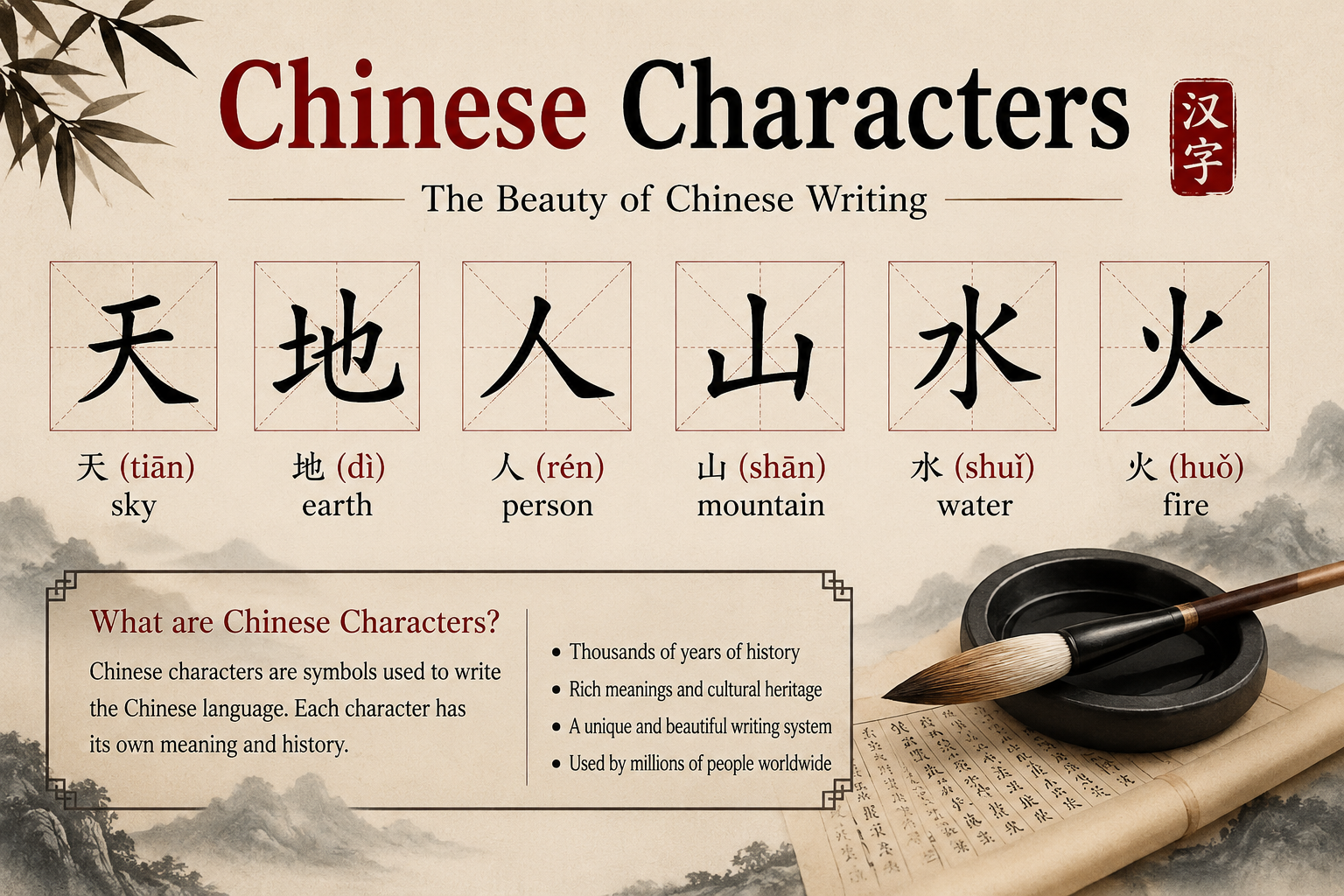
Learning Chinese can seem intimidating at first, especially when faced with thousands of unique characters. However, understanding the fundamentals of how Chinese characters work can transform your learning journey from overwhelming to manageable. This guide introduces you to the basics of Chinese characters and provides practical insights to help you begin your study with confidence.
What Are Chinese Characters?
Chinese characters, known as “hanzi” (汉字), are a writing system that has evolved over thousands of years. Unlike alphabetic systems like English, where letters represent individual sounds, Basic Chinese Characters are logographic. This means each character typically represents a complete word or meaningful unit, combining visual elements to convey meaning and sound.
The most fascinating aspect of Chinese characters is their visual nature. Many characters contain pictures of what they represent. For example, the character for “tree” (木) literally looks like a tree with branches. The character for “sun” (日) resembles a circle with a line through it, mimicking the appearance of the sun. Understanding these visual origins makes learning characters more intuitive and memorable.
The Structure of Chinese Characters
Chinese characters are built from smaller components called radicals and strokes. A stroke is a single line drawn in a specific direction, and characters are composed of multiple strokes combined in particular ways. Most characters contain between 5 and 15 strokes, though some complex characters may contain many more.
Radicals are the fundamental building blocks of Chinese characters. There are 214 traditional radicals, and they often appear in the left, right, top, or bottom portion of a character. These radicals frequently relate to the character’s meaning. For instance, characters with the “water” radical (氵) often relate to liquids or wetness. By learning common radicals, you gain insight into character meanings and make studying more efficient.
Categories of Chinese Characters
Understanding the different character categories helps clarify how Chinese writing developed:
Pictographic Characters directly represent objects. The character for “horse” (马) originally depicted a horse with four legs, though modern versions are simplified. These are the most intuitive characters for beginners.
Ideographic Characters represent abstract concepts through images or symbols. The character for “up” (上) has a line above another line, while “down” (下) reverses this arrangement. These characters help you understand how Chinese expresses concepts visually.
Compound Characters combine two or more characters to create new meanings. For example, combining the characters for “fire” (火) with itself twice creates “blazing” (炎). Learning these relationships reveals patterns in character creation.
Phonetic Characters are the most numerous category. These combine a radical indicating meaning with a component suggesting pronunciation. This category makes up the majority of modern Chinese characters, making it essential for comprehensive learning.
Simplified vs. Traditional Characters
Two main forms of written Chinese exist: Simplified and Traditional characters. Simplified characters, adopted in mainland China in the 1950s, have fewer strokes and are easier to write. Traditional characters, used in Taiwan and Hong Kong, maintain more complex original forms and historical detail.
For new learners, Simplified Chinese is often recommended as a starting point due to its reduced complexity and widespread use. However, learning either form provides a foundation that makes learning the other form more manageable, as they share fundamental principles and structure.
How Many Characters Do You Need to Learn?
This question concerns many beginners. The good news is that you don’t need to learn all Chinese characters to achieve basic proficiency. Approximately 2,000 characters cover roughly 98% of everyday written Chinese. For reading newspapers or novels, 3,000 characters suffice. Most educated speakers know around 8,000 characters, though many are rarely used.
Starting with the most common characters is the smart approach. Characters like “人” (person), “大” (big), “小” (small), and “水” (water) appear frequently and form the foundation for understanding more complex characters.
Practical Tips for Learning Characters
Start with radicals: Learning the 20-30 most common radicals provides context for countless characters. This foundation accelerates your overall progress significantly.
Understand stroke order: Learning Chinese Alphabet have specific stroke orders, typically written from top to bottom and left to right. Learning correct stroke order improves memory retention and handwriting accuracy.
Use spaced repetition: Reviewing characters at increasing intervals reinforces memory. Apps and flashcard systems make this approach practical and effective.
Write them out: While recognizing characters on a page matters, actively writing characters strengthens neural pathways and improves retention considerably.
Learn characters in context: Rather than memorizing characters in isolation, learn them within words and sentences. This approach provides meaning and practical application immediately.
Conclusion
Chinese characters may initially appear complex and mysterious, but their logical structure and visual foundation make them learnable through systematic study. By understanding radicals, recognizing character patterns, and focusing on high-frequency characters first, you can build a solid foundation.
Remember that learning Chinese is a marathon, not a sprint. Progress may feel slow initially, but each character learned is a building block toward fluency. With patience, consistent practice, and curiosity about the writing system’s history and structure, you’ll find that Chinese characters transition from intimidating symbols into meaningful and even beautiful components of a rich written language. Start today with the basics, and watch as the world of Chinese language gradually opens before you.