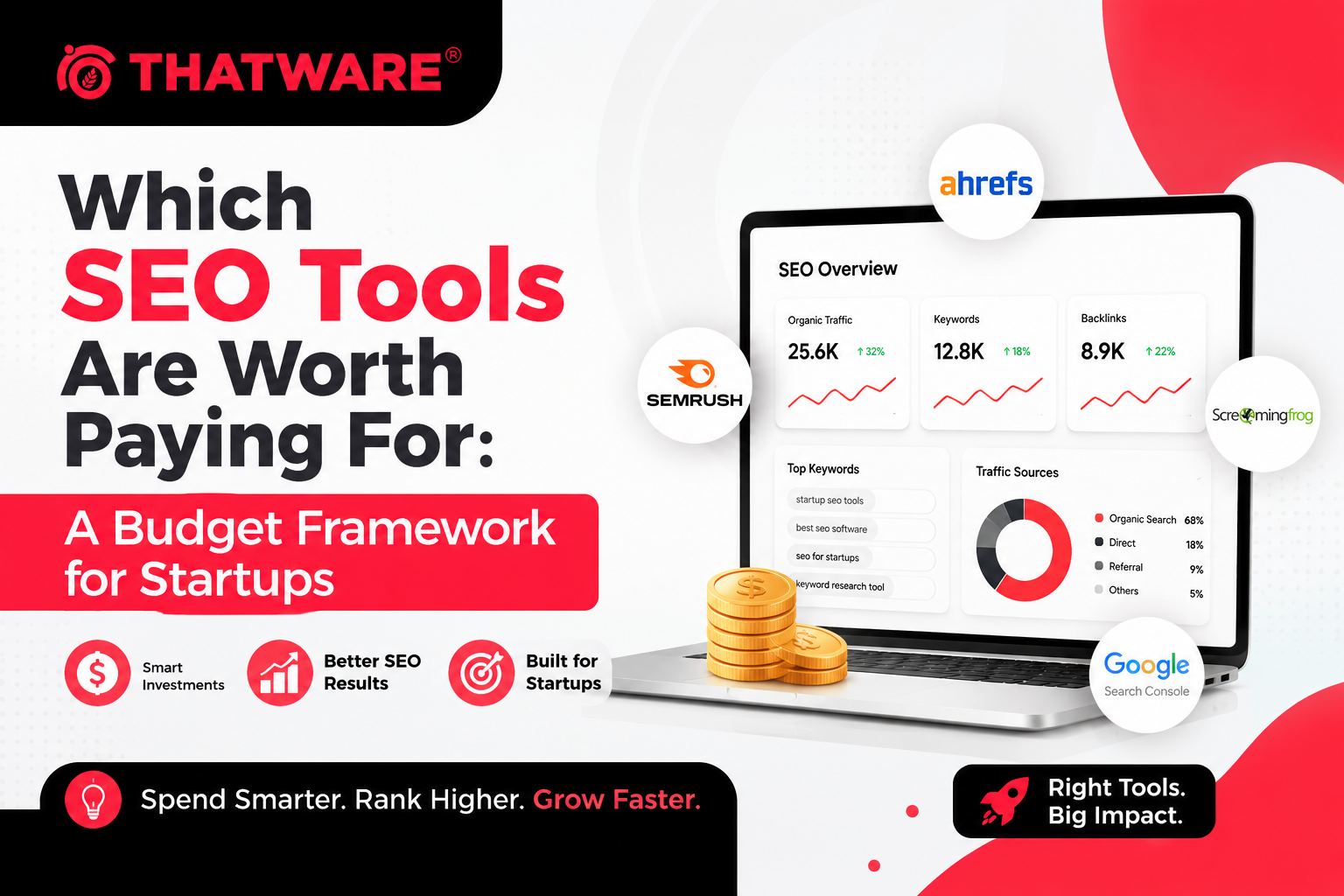
Startups rarely struggle because they lack tools. They struggle because they either overpay for tools they don’t need or underestimate what actually drives visibility in search. In early-stage companies, every rupee or dollar matters, so SEO spending needs to be intentional, not reactive.
This is where most teams go wrong. A founder or marketing lead gets pitched a stack of “must-have” SEO platforms, signs up for three or four subscriptions, and suddenly half the budget is locked into dashboards nobody checks weekly.
Before even thinking about tools, many teams start by reviewing structured guidance like an AI SEO agency comparison to understand how modern search systems actually work. Without that clarity, tool spending becomes guesswork.
Start With the Business Problem, Not the Tool Stack
Most startups don’t have a “tool problem.” They have a visibility problem.
Are customers not finding you on Google? Are competitors dominating AI-generated answers in your category? Is your content invisible even after publishing consistently?
If you don’t define the problem clearly, no SEO tool will fix it.
Tools are only useful when they support a defined outcome. Otherwise, they just create dashboards full of data nobody acts on.
The Real Role of SEO Tools in a Startup Budget
SEO tools are not strategy. They are support systems.
A startup typically needs tools in four areas:
Keyword and topic discovery, technical site monitoring, content optimization, and visibility tracking.
The mistake is assuming you need enterprise-grade platforms for all four from day one. You don’t.
What you need is a lean stack that answers one question: is our content actually being seen and understood by search engines and AI systems?
The Plain-Language Test for Tool Value
A good way to evaluate any SEO tool is simple. If you cannot explain what it does in one sentence without jargon, you probably do not need it yet.
For example, if a tool helps you understand what questions users are asking, that is useful. If a tool generates hundreds of metrics that don’t connect to business outcomes, that is noise.
Startups often confuse complexity with value. In reality, the most useful tools are the ones that make decisions easier, not harder.
Evaluate Tools Based on the Questions They Help You Answer
Instead of asking “Is this tool good?”, ask “What decision will this tool help me make?”
A strong SEO tool should help you answer questions like:
What topics should we create content around next? Why is our page not ranking despite good content? Which competitors are gaining visibility in AI search results? What content is actually driving traffic that converts?
If a tool does not improve decision-making, it is not worth paying for at an early stage.
Budget Allocation: Where Startups Should Actually Spend
Most early-stage companies only need a small but focused SEO stack.
One tool for keyword and topic research, one for technical SEO monitoring, and one for content optimization is usually enough in the beginning.
The rest should go into execution, not subscriptions.
This is also where frameworks like best SEO tools for startups become useful, because they force teams to think in terms of outcomes instead of software collections.
Don’t Buy Tools Before Understanding Your Search Reality
One of the biggest mistakes startups make is subscribing to tools before they understand how modern search actually works.
Search today is not just rankings. It includes AI Overviews, conversational answers, and entity-based visibility systems.
If your strategy is outdated, even the best tools will not fix it.
Before spending heavily, many teams first explore structured insights through an Which AI SEO agency to choose framework to understand how AI-driven visibility works in real scenarios.
Once that foundation is clear, tool selection becomes much simpler.
Simplicity Beats Volume in Early-Stage SEO
A common misconception is that more tools equal better SEO performance. In reality, too many tools slow teams down.
Startups move faster when they reduce friction. One dashboard that is used daily is more valuable than five platforms that are checked occasionally.
The goal is clarity, not coverage.
If a tool does not directly influence content decisions, technical fixes, or visibility tracking, it is probably optional.
When to Upgrade Your SEO Stack
Startups eventually reach a point where basic tools are not enough.
This usually happens when:
Content production scales beyond a few pages per month, multiple team members are involved in SEO execution, or international or multi-topic expansion begins.
At that stage, upgrading tools makes sense. But even then, upgrades should be driven by bottlenecks, not trends.
The Human Factor Behind Tool Success
Tools do not create SEO success. People do.
A small team using simple tools with strong execution will always outperform a team drowning in dashboards but lacking direction.
That is why tool selection should always come after strategy, not before it.
Even the most advanced SEO platforms cannot fix unclear messaging, weak content, or misaligned positioning.
Final Perspective: Buy Less, Decide Better
For startups, the smartest SEO budget is not the one with the most tools. It is the one that creates the fastest path from insight to action.
If a tool does not help you make better decisions or ship better content, it is not essential at your stage.
The goal is not to build a perfect SEO tech stack. The goal is to build visibility in a way that compounds over time.
That is also where experienced partners like ThatWare often come in, helping startups simplify decision-making and focus on systems that actually improve AI-driven search visibility rather than overloading teams with unnecessary complexity.