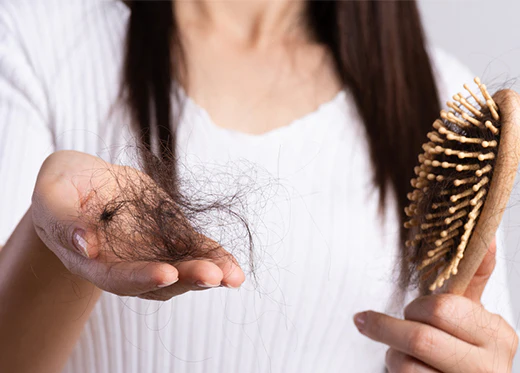
Most women start with thickening shampoos, scalp serums, biotin, and minoxidil. These work for some. For many, they eventually plateau. The part line keeps widening. The scalp still shows. When topical treatments stop making a difference, the next step requires a different kind of expertise.
Why Over-the-Counter Products Have Limits
Minoxidil, the most common FDA-approved topical for hair loss, works by extending the growth phase of the hair cycle and increasing blood flow to the follicles. For women with early-stage androgenetic alopecia, it can help maintain density and sometimes stimulate modest regrowth.
But minoxidil doesn’t work for everyone. It’s less effective for women with autoimmune-related hair loss like alopecia areata. It won’t restore hair in areas where follicles have already miniaturized beyond recovery. And it requires consistent, indefinite use. Stopping treatment often means losing whatever progress was made.
For women dealing with trichotillomania, the equation is different entirely. The hair loss results from pulling behaviors, not follicle dysfunction. Topical treatments don’t address the underlying cause, and the damage patterns require specialized coverage strategies.
Those searching for hair loss solutions for women Dallas after exhausting over-the-counter options need providers who understand these distinctions and can recommend approaches based on the actual cause and progression of the loss.
The Conditions That Require Specialized Intervention
Hair loss is not one condition. It presents differently depending on the underlying cause, and each cause responds to different interventions.
- Androgenetic alopecia in women typically shows as diffuse thinning across the crown and top of the scalp, with the hairline often remaining intact. This type of loss is progressive and genetic. Toppers and lightweight extensions can restore density in affected areas while protecting remaining hair.
- Alopecia areata creates patchy, unpredictable loss that can appear suddenly and may or may not regrow on its own. Women with this condition often experience cycles of loss and regrowth that make planning difficult. Integration systems and custom toppers can provide coverage that adapts as the condition changes.
- Traction alopecia results from years of tight styling, braids, or extensions placed with too much tension. The hairline and temples are commonly affected. V-Light extensions and targeted bonding techniques can restore density in these fragile areas without adding further stress.
- Trichotillomania involves pulling behaviors that create specific patterns of loss, often concentrated in areas the hands naturally reach. Mesh integration provides coverage that also serves as a physical barrier, which some women find helpful in interrupting the pulling cycle.
A women’s hair loss specialist in Dallas recognizes these patterns and tailors recommendations accordingly. The approach for diffuse hormonal thinning looks different from the approach for patchy autoimmune loss or pulling-related damage.
What Specialized Consultations Actually Assess
A consultation with a hair loss specialist goes beyond measuring how much hair remains. It includes evaluating the scalp for inflammation or sensitivity, mapping density across different zones, and understanding whether the loss is stable or progressing.
Specialists also assess hair integrity. Fragile strands require gentler methods than resilient hair. Bond size, placement, and maintenance frequency all depend on this evaluation. Hair loss solutions for women in Dallas should be built on this level of assessment.
The Methods That Work When Products Don’t
Non-surgical hair restoration has advanced considerably. Women who assume their only options are wigs or continued decline often don’t know what exists in between.
- Hair toppers provide targeted coverage for the crown, part line, or frontal area. They range from small pieces covering a few inches to larger bases covering the entire top of the head. Attachment options include clips for daily wear or microbeads and bonds for semi-permanent placement lasting four to six weeks.
- Mesh integration anchors a breathable mesh base onto existing hair, allowing natural hair to blend through while adding density across the entire scalp. This method suits moderate to advanced thinning and works well for conditions like trichotillomania, where full coverage provides both cosmetic and functional benefits.
- V-Light extensions use a flexible bonding technique ideal for extremely fine hair or delicate areas like the hairline and temples. The bonds are nearly invisible and add density without detectable weight.
Each method has specific candidacy requirements. A women’s hair loss specialist Dallas determines which approach fits based on remaining density, scalp condition, lifestyle factors, and the guest’s goals.