
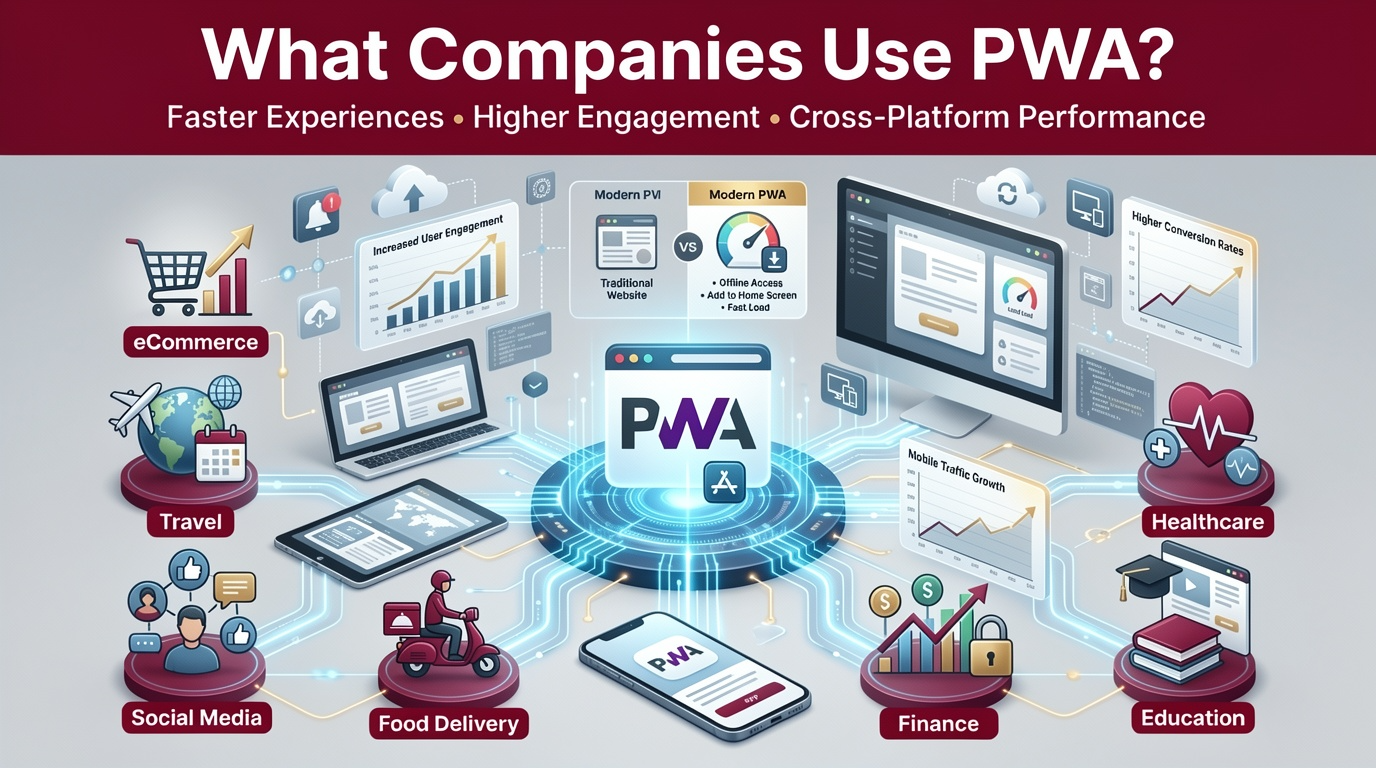
As businesses continue searching for faster, more cost-effective ways to deliver exceptional digital experiences, progressive web application development services have become a popular choice across multiple industries. Progressive Web Applications (PWAs) combine the accessibility of websites with the functionality of mobile applications, allowing organizations to provide fast, reliable, and engaging user experiences without requiring users to download traditional apps. From global corporations to growing startups, companies around the world are increasingly adopting PWAs to improve performance, increase engagement, and streamline development efforts.
The growing popularity of PWAs has led many business owners to ask an important question: What companies use PWA, and why are so many organizations embracing this technology?
The answer lies in the unique advantages that PWAs offer, including faster load times, offline functionality, improved user engagement, lower development costs, and cross-platform compatibility.
Understanding Progressive Web Applications
Before exploring which companies use PWAs, it is important to understand what makes this technology unique.
A Progressive Web Application is a web-based solution that behaves similarly to a native mobile application. Users can access the application through a web browser while enjoying features traditionally associated with mobile apps.
These features often include:
- Offline access
- Push notifications
- Home screen installation
- Fast loading speeds
- Responsive design
- Cross-platform functionality
- Secure browsing experiences
Unlike traditional mobile applications, PWAs do not require distribution through app stores, making them easier for users to access and businesses to maintain.
Why Companies Are Choosing PWAs
Consumer expectations have changed dramatically over the past decade.
Users expect websites and applications to load quickly, function smoothly, and provide consistent experiences regardless of device or internet connection quality.
Traditional websites often struggle to meet these expectations, while native applications can require significant development and maintenance investments.
PWAs bridge this gap by providing:
- Improved performance
- Lower development costs
- Enhanced accessibility
- Simplified maintenance
- Broader audience reach
- Increased user engagement
These advantages explain why businesses across various industries continue adopting PWA technology.
Major Companies That Use PWAs
Many globally recognized brands have embraced Progressive Web Applications as part of their digital strategies.
Alibaba
One of the world’s largest eCommerce companies successfully implemented a PWA to improve mobile shopping experiences.
The company focused on increasing engagement, reducing loading times, and improving conversion rates.
The results demonstrated how PWAs can support large-scale online retail operations while enhancing user satisfaction.
Starbucks
Starbucks developed a Progressive Web Application to provide customers with a fast and reliable ordering experience.
The application allows users to browse menus, customize orders, and access important features even when internet connectivity is limited.
This approach helped create a seamless customer experience across devices.
Pinterest adopted PWA technology to improve mobile performance and engagement.
By focusing on speed and accessibility, the company created a more efficient user experience that encouraged greater interaction with content.
The improved performance contributed to increased user activity and retention.
Twitter’s PWA, known as Twitter Lite, became a widely recognized example of successful Progressive Web Application implementation.
The platform was designed to perform efficiently even in areas with slower internet connections.
The lightweight application improved accessibility while maintaining key social networking features.
Uber
Uber developed a PWA solution designed to function effectively on low-speed networks and older devices.
This approach expanded accessibility and improved usability for users in regions where advanced smartphones or high-speed internet may not always be available.
Forbes
Media organizations have also embraced Progressive Web Applications.
Forbes implemented PWA technology to improve content delivery, increase page speed, and enhance reader engagement.
Faster loading times contributed to a better overall user experience.
Trivago
The travel industry has benefited significantly from PWA adoption.
Trivago implemented a Progressive Web Application to streamline hotel searches and booking experiences.
Improved performance and accessibility helped users interact more effectively with the platform.
Industries Benefiting from PWAs
Although many well-known companies use PWAs, the technology is not limited to large enterprises.
Organizations across numerous industries are adopting Progressive Web Applications.
eCommerce
Online retailers benefit from:
- Faster product browsing
- Improved checkout experiences
- Reduced cart abandonment
- Enhanced mobile performance
- Greater customer engagement
PWAs help create shopping experiences that closely resemble native mobile applications while maintaining web accessibility.
Healthcare
Healthcare organizations use PWAs to provide:
- Patient portals
- Appointment scheduling
- Health information resources
- Telemedicine services
- Secure communication platforms
Accessibility and reliability are especially important in healthcare environments.
Education
Educational institutions increasingly utilize PWAs to deliver:
- Online learning platforms
- Student portals
- Digital resources
- Virtual classrooms
- Collaboration tools
Students can access educational content from virtually any device.
Financial Services
Banks and financial institutions use PWAs to provide secure digital experiences while maintaining performance and accessibility.
Features often include:
- Account management
- Transaction monitoring
- Customer support
- Financial planning tools
- Secure authentication
Hospitality and Travel
Hotels, airlines, and travel agencies use PWAs to improve:
- Booking systems
- Travel updates
- Customer service
- Reservation management
- User engagement
Travel-related businesses often prioritize accessibility and performance across multiple devices.
Key Advantages Driving PWA Adoption
The widespread adoption of PWAs is largely driven by their practical business benefits.
Lower Development Costs
Developing separate applications for Android, iOS, and web platforms can be expensive.
PWAs allow organizations to maintain a single codebase that serves multiple platforms.
This approach reduces development expenses while simplifying ongoing maintenance.
Faster Time to Market
Because businesses can deploy one application across multiple devices, development timelines are often shorter.
Faster deployment enables organizations to respond more quickly to market opportunities and customer needs.
Improved Performance
Speed plays a major role in user satisfaction.
PWAs utilize advanced caching mechanisms that help applications load quickly and perform efficiently.
Improved performance often leads to:
- Higher engagement
- Lower bounce rates
- Increased conversions
- Better customer retention
Enhanced Accessibility
Users can access PWAs instantly through a web browser without downloading large application files.
This reduces friction in the customer journey and increases accessibility for broader audiences.
Offline Functionality
One of the most valuable PWA features is the ability to function even when internet connectivity is limited.
Users can continue interacting with important content and features, improving overall usability.
PWA vs Native Mobile Applications
Many organizations evaluate whether to invest in native applications or Progressive Web Applications.
The right choice depends on specific business objectives.
Advantages of Native Apps
Native applications offer:
- Maximum performance
- Deep hardware integration
- Advanced device functionality
- Platform-specific experiences
These benefits may be important for highly complex applications.
Advantages of PWAs
PWAs provide:
- Cross-platform compatibility
- Lower development costs
- Faster deployment
- Simplified maintenance
- Search engine visibility
- Improved accessibility
For many businesses, these advantages make PWAs an attractive alternative to native development.
The Future of Progressive Web Applications
The future of PWAs appears increasingly promising.
As browser technologies continue advancing, Progressive Web Applications are becoming more capable and powerful.
Several trends are accelerating adoption.
Improved Browser Support
Modern browsers continue expanding support for advanced PWA features, making implementation more effective across platforms.
AI Integration
Artificial intelligence is increasingly being incorporated into web applications to provide personalized user experiences and intelligent automation.
Cloud-Native Development
Cloud technologies support scalability and performance while enabling more sophisticated web-based applications.
Enhanced Security
Security improvements continue strengthening user trust and protecting sensitive information.
Enterprise Adoption
More enterprise organizations are recognizing the value of PWAs as cost-effective alternatives to traditional application development approaches.
As these trends continue, PWAs are expected to play a larger role in digital transformation initiatives across industries.
How Businesses Can Determine If a PWA Is Right for Them
Not every organization requires a native mobile application.
Businesses should consider a PWA when they want to:
- Reduce development costs
- Improve mobile experiences
- Reach broader audiences
- Increase engagement
- Simplify maintenance
- Support multiple devices
- Accelerate deployment
Organizations focused on accessibility, performance, and scalability often find PWAs particularly beneficial.
The ability to combine website accessibility with app-like functionality creates significant value for both businesses and users.
Common Use Cases for PWAs
Progressive Web Applications support a wide variety of business solutions.
Popular examples include:
- Customer portals
- Online marketplaces
- Learning platforms
- Healthcare systems
- Booking applications
- Membership websites
- Community platforms
- Corporate intranets
- Service portals
- Content publishing systems
Their flexibility makes them suitable for organizations of all sizes and industries.
Conclusion
Many of the world’s most recognized companies, including Alibaba, Starbucks, Pinterest, Twitter, Uber, Forbes, and Trivago, have embraced Progressive Web Applications to improve user experiences, increase engagement, and reduce development complexity. Their success demonstrates the growing value of PWA technology across industries ranging from eCommerce and healthcare to education, finance, and travel. As consumer expectations continue evolving, businesses increasingly need digital solutions that combine speed, accessibility, reliability, and scalability. Progressive Web Applications provide an effective way to achieve these goals while reducing costs and simplifying maintenance. For organizations seeking innovative web solutions built with modern technologies, responsive design, cloud integration, enterprise functionality, and future-ready performance, Vibrant Logics delivers customized development services designed to help businesses leverage the full potential of Progressive Web Applications and achieve long-term digital success.