
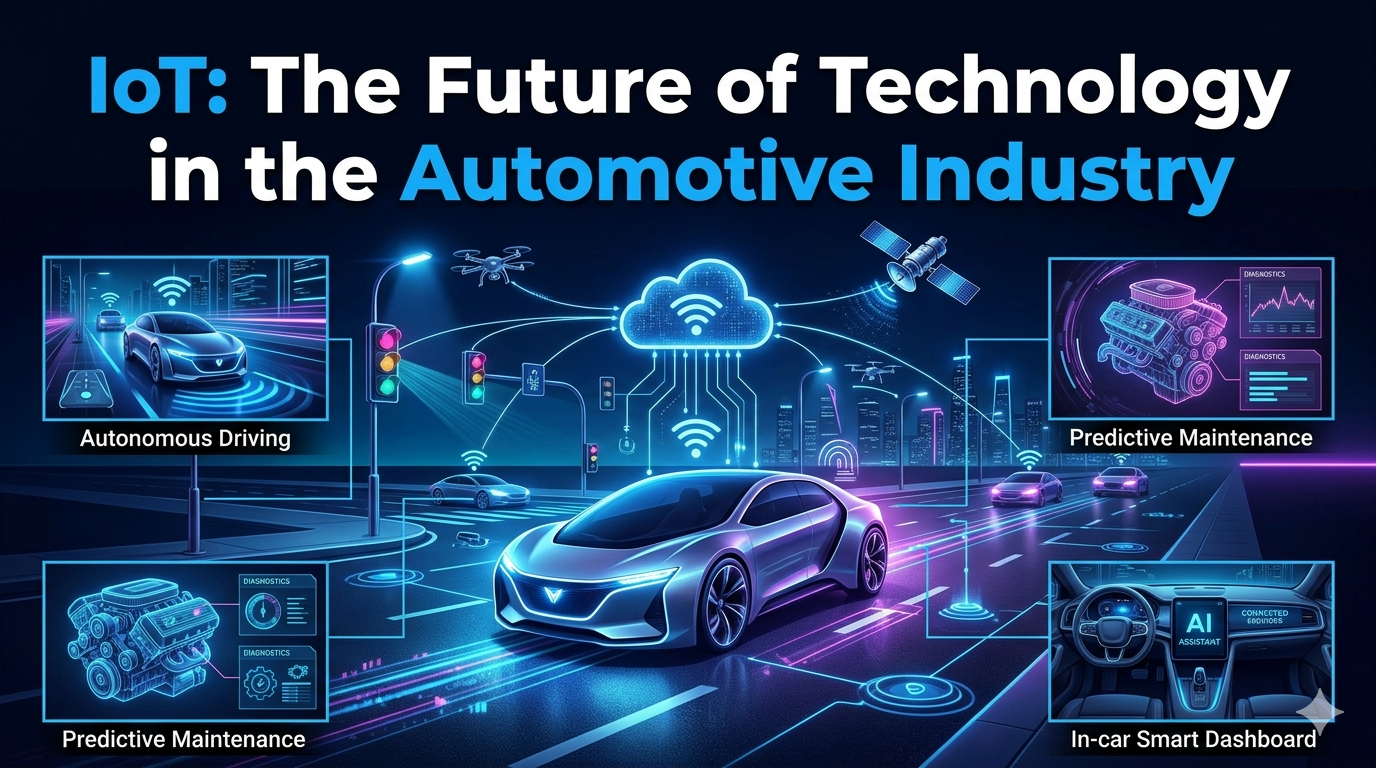
Think about the last time you drove a car. Maybe your dashboard pinged about low tire pressure. Maybe your GPS rerouted you automatically. Maybe your car parked itself while you just sat back. None of that happens by magic; it’s the Internet of Things (IoT) quietly doing its job, and it’s only getting started.
The automotive world is in the middle of a massive transformation. Vehicles are no longer just machines that take you from point A to point B. They’ve become rolling computers, constantly collecting data, making decisions, and talking to the world around them. This shift is powered by IoT, and it’s reshaping everything from how cars are manufactured to how they’re driven, maintained, and insured.
So, what exactly is automotive IoT, and why does it matter so much right now? Let’s break it down.
What is Automotive IoT?
Automotive IoT may be described as the deployment of sensors, software, cloud services, and connectivity within automobiles to facilitate their interaction with other cars, infrastructure around them, and with their drivers. In essence, it’s about hooking up the brain of your car to its sensory nerves for feeling, thinking, and reacting.
It’s beyond mere satellite navigation or connecting your smartphone to your car. The advanced automotive IoT systems that we have today allow for engine diagnostics, driver security, software updates on the go, fleet management, and autonomous driving.
Take note of the investments pouring into this technology. According to reports, the global market value for automotive IoT stood at about $153 billion in 2024 and is expected to exceed $1 trillion by 2034, growing at a CAGR above 21%.
The Rise of Connected Cars
Perhaps the most tangible result of IoT in the automotive sector is the connected car – a car that is permanently connected to the internet, and as such to other cars, traffic infrastructure, and services.
Connected cars use a network of sensors, an on-board computer, and mobile data connections to communicate. This makes it possible to do real-time route planning, remote diagnostics, automatic emergency calls, and even tailoring the driving experience to the driver’s tastes.
This is made possible by Vehicle-to-Everything (V2X) communication. V2X enables vehicles to communicate not only with other vehicles (V2V), but also with traffic signals and other infrastructure (V2I), with people (V2P), and with the cloud (V2C). This creates a connected, intelligent traffic system that decreases traffic jams, minimises accidents, and makes driving less infuriating.
Predictive Maintenance: Proactive, not Reactive
Perhaps the most valuable IoT application for most drivers in their day-to-day lives is predictive maintenance, and it’s probably one of the most significant.
Up until now, car maintenance has been reactive: if something fails, replace it. Or if you’re lucky, time-based (change the oil after 5,000 km regardless of whether it’s needed or not). IoT turns this approach on its head.
IoT sensors integrated into the vehicle constantly monitor key components – engine health, tire pressure, battery charge, brake wear, and so on. This information is transmitted to the cloud, where machine learning algorithms can detect early signs of fault. Rather than finding out about a problem when your vehicle fails on the motorway, you’re alerted a few days or weeks ahead, with recommendations for what to check.
An example of this is BMW’s ConnectedDrive system, which notifies you in advance of maintenance items. On the factory floor, BMW also uses AI for predictive maintenance in its Regensburg plant to prevent more than 500 minutes of lost production time annually for vehicle assembly alone.
Predictive maintenance is even more game-changing for fleet managers, as it can minimise breakdowns, reduce maintenance costs, and maximise the uptime of fleets.
Autonomous Vehicles: Where We’re Headed
When we talk about IoT and automotive, we couldn’t ignore autonomous vehicles (AVs) – the technology that’s getting the most attention.
AVs are the most sophisticated use of IoT in vehicles. AVs use a complex mix of sensors (cameras, LiDAR, radar, ultrasonics) to gather data, stream it for real-time processing and AI-based decision-making, and connect to external systems. An autonomous vehicle generates and processes a huge amount of data every second to perceive its surroundings, anticipate the intentions of other traffic participants, and decide on the best course of action.
The Society of Automotive Engineers (SAE) categorises vehicles into five levels of automation:
Level 1: Driver assistance (e.g., cruise control)
Level 2: Augmented systems such as adaptive cruise control – driver still vigilant
Level 3: Conditional automation
Level 4: High automation; human needed only occasionally
Level 5: Full automation; no human intervention
Personal cars are currently at Level 2. However, companies such as Waymo, Tesla and Cruise are driving towards Level 4 and beyond. The payoffs are huge: fewer car accidents (the majority of which are due to human error), greater transportation options for the elderly and the disabled, and enormous improvements in fuel efficiency as cars drive more predictably and harmoniously with each other.
IoT in Action: ADAS Driving Safety
Even before the days of the self-driving vehicle, Advanced Driver Assistance Systems (ADAS) are already here to save the day. ADAS is a range of IoT technologies that help drivers in real time – and it’s quickly becoming a must-have for all types of vehicles.
Examples include:
Automatic Emergency Braking (AEB) – senses when a collision is about to occur and brakes quicker than humanly possible
Lane Departure Warning System (LDWS) – warns when a driver is about to stray out of their lane
Adaptive Cruise Control – automatically adjusts speed to the car in front
Blind Spot Detection – alerts to vehicles in blind spots
Traffic Sign Recognition – recognises traffic signs and displays them on the dashboard
Connected Infotainment in the Car
Car buyers now expect the digital interface of their car to be as smart as their phone. This is made possible by IoT through intelligent infotainment that brings together navigation, entertainment, communication, and vehicle controls into a unified experience.
Smart assistants provide voice-activated music, phone calls, navigation, and even climate control. Live traffic information dynamically guides the driver. Music and podcast streaming, and app stores, bring the phone to the car. Some can even learn from your driving habits to adapt to your preferences.
Over-the-Air (OTA) software updates are an evolution of this; just like your phone gets new system software overnight, your connected vehicle could receive system updates, features, and security patches without even visiting the dealership. This was pioneered by Tesla and is quickly becoming the industry standard.
Challenges on the Road Ahead
This doesn’t come without its challenges. As automotive IoT permeates our cars and our cities, there are a couple of obvious issues that need to be tackled:
Cybersecurity: There’s no doubt that connected vehicles are connected to the internet – and therefore vulnerable to cybersecurity risks. Vehicle security, data privacy, and assurance that essential safety functions can’t be interfered with are must-haves for the industry.
Connectivity Gaps: For vehicles to operate in a semi- or fully autonomous way, they need fast and reliable data links. Gaps in coverage still remain in rural and emerging markets that must be addressed – in part through the rollout of 5G technologies, and eventually 6G.
Data Privacy: Connected cars produce vast amounts of information about drivers, their movements, and behaviours. Sound regulations, transparent data practices, and effective consent processes should be in place to build trust.
Interoperability: Different systems and standards are used by different manufacturers. Open standards and protocols are required to drive the connected mobility vision – where vehicles, infrastructure, and services communicate with each other.
High Cost of Implementation: There are high costs in integrating IoT technologies into vehicles and production facilities, which may be prohibitive – particularly for smaller actors in the ecosystem.
Future Trends of IoT, 5G, and the Smart City
The future of IoT automotive solutions will depend greatly on the deployment of 5G technology, providing connectivity that allows ultra-low latency and high speed required for the operation of autonomous cars. At the same time, the automotive industry is the largest segment of the 5G IoT market, representing 26% of all IoT connections globally, where the technology helps cars navigate and communicate with everything around them.
However, IoT-enabled cars will also help the smart city achieve its goals. Connected cars will help cities better regulate the flow of traffic, locate spots with available parking, find out about problems with road surface like potholes, and allocate funding for construction depending on how roads are used. The IoT car is thus both personal and a public good at once.
Suzuki R&D Centre India: Driving the future of Innovation
In an ever-evolving IoT environment, research and development are more important than ever. That’s where research and development centres such as the Suzuki R&D Centre India (SRDI) come into the picture.
The Suzuki R&D Centre India is a centre of automotive innovation, dedicated to creating technology that caters to India’s road conditions and challenges, without compromising on international standards. With a renewed focus on smart vehicle technologies, electric vehicles (EVs), and next-generation safety systems, SRDI is part of the Suzuki Group’s mission to create intelligent, safe, and eco-friendly vehicles.
If you are looking for cutting-edge vehicle technologies – from connected safety systems to electric vehicles (EVs) – Suzuki R&D Centre India is an innovative leader.
Frequently Asked Questions (FAQs)
Q1. What is IoT in the automotive industry?
Automotive IoT refers to the integration of internet-connected sensors, devices, software, and cloud systems into vehicles and manufacturing processes. It enables real-time data collection, vehicle-to-vehicle communication, predictive maintenance, autonomous driving capabilities, and smarter fleet management.
Q2. How does IoT improve vehicle safety?
IoT powers Advanced Driver Assistance Systems (ADAS) like automatic emergency braking, lane departure warnings, adaptive cruise control, and blind spot detection. By processing sensor data in real time, these systems help prevent accidents and reduce the impact of human error on the road.
Q4. What are connected cars?
Connected cars are vehicles equipped with internet connectivity and communication technology that allows them to exchange data with other vehicles (V2V), infrastructure (V2I), pedestrians (V2P), and cloud networks (V2C). This connectivity enables smarter navigation, real-time diagnostics, remote monitoring, and a more personalized driving experience.
Q5. When will fully autonomous vehicles be on the roads?
True Level 5 autonomy, where a vehicle requires no human input whatsoever, is still in development. Some Level 4 vehicles (which can operate autonomously in defined conditions) are already being tested in specific markets by companies like Waymo. Broader commercial availability of highly automated vehicles is generally expected to unfold progressively through the late 2020s and into the 2030s.
Q6. What role does 5G play in automotive IoT?
5G provides the ultra-fast, low-latency connectivity that advanced automotive IoT applications require. It enables the real-time data exchange needed for autonomous driving, V2X communication, and high-definition mapping, all of which demand near-instant data transmission that previous cellular generations couldn’t reliably deliver.
Q7. Is automotive IoT data safe and private?
Data privacy and cybersecurity are among the most important challenges in automotive IoT. Reputable manufacturers and IoT providers implement encryption, identity management, access controls, and regular security audits to protect vehicle systems and user data. Regulatory frameworks like ISO/SAE 21434 for cybersecurity and GDPR in Europe are also shaping how automotive data is managed.
Sources
- Codewave Insights — How IoT Transforms the Automotive Industry: Use Cases and Benefits — https://codewave.com/insights/iot-transforms-automotive-industry-use-cases-benefits/
- GoodFirms — Top Trends in Automotive IoT to Watch in 2026 and Beyond — https://www.goodfirms.co/blog/top-trends-automotive-iot
- Appinventiv — IoT in the Automotive Industry: Transforming Mobility — https://appinventiv.com/blog/iot-in-automotive-industry/
- Rejig Digital — How IoT is Transforming the Automotive Industry — https://www.rejigdigital.com/blog/iot-in-automotive-industry/
- Onomondo — IoT: The Future of Technology in the Automotive Industry — https://onomondo.com/blog/iot-the-future-of-technology-in-the-automotive-industry/
- Onomondo — How IoT Drives the Future of Fleet Management — https://onomondo.com/blog/iot-the-future-of-fleet-management/

