The wireless landscape in 2026 is evolving faster than ever. With widespread 5G deployments, early 6G research, and the rapid expansion of connected devices, engineers face growing pressure to validate performance at higher frequencies with greater precision. Millimeter wave (mmWave) technologies, operating well above traditional cellular bands, introduce new complexities that conventional test environments simply cannot handle.
This is where RF Chamber Testing becomes mission-critical. Controlled RF environments enable accurate measurement of antenna performance, radiation patterns, beamforming behavior, and device reliability under repeatable conditions. As device density increases and regulatory requirements tighten, organizations that invest in robust chamber-based validation gain a significant competitive advantage.
Whether you are designing next-generation smartphones, automotive radar systems, or fixed wireless access equipment, understanding how to plan and execute effective chamber testing is essential for success.
Key Takeaways
- RF chamber environments are essential for accurate mmWave and 5G validation.
- Proper chamber design directly impacts measurement repeatability and compliance.
- Beamforming and OTA testing demand specialized positioning and calibration.
- Strategic planning helps reduce test time while improving data quality.
- Selecting the right partner and architecture ensures long-term scalability.
Why mmWave and 5G Testing Demands a New Approach
Traditional sub-6 GHz testing methods cannot fully address the behavior of mmWave signals. At frequencies above 24 GHz, propagation characteristics change dramatically. Signals experience higher path loss, increased sensitivity to blockage, and more directional beam patterns.
Because of this, engineers must rely on highly controlled environments to eliminate external interference and reflections. Even minor environmental variations can distort results at mmWave frequencies.
Modern wireless products also integrate advanced technologies such as:
- Massive MIMO
- Adaptive beamforming
- Phased array antennas
- Dynamic spectrum usage
These innovations improve performance but significantly increase validation complexity. Engineers must now evaluate not just signal strength but spatial behavior, beam accuracy, and real-world usage scenarios.
Understanding the Role of RF Chambers
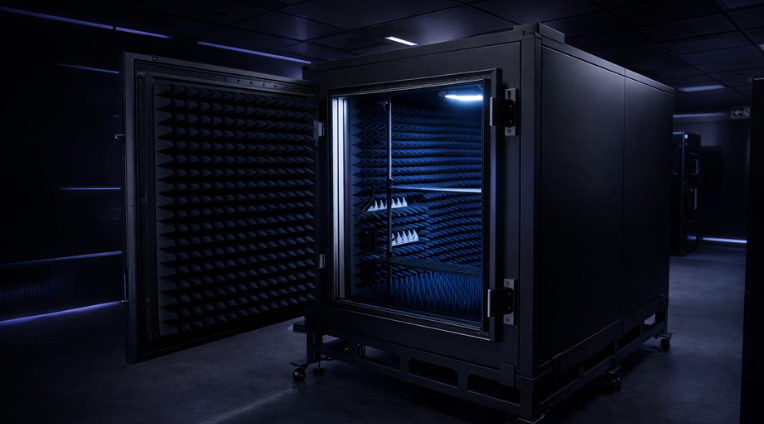
At its core, RF Chamber Testing creates a shielded and absorptive environment that simulates free-space conditions. By isolating the device under test (DUT) from external signals and reflections, engineers can capture precise, repeatable measurements.
A typical RF chamber setup includes:
- RF shielding enclosure
- Anechoic absorbers
- Positioning systems
- Measurement antennas
- Control and automation software
For mmWave and 5G applications, chamber performance requirements are far more stringent than legacy systems. Even small imperfections in absorber performance or chamber geometry can introduce measurement errors.
The goal is simple: reproduce real-world RF behavior inside a fully controlled laboratory environment.
Key Challenges Engineers Must Address
1. High Path Loss at mmWave Frequencies
MmWave signals attenuate rapidly with distance. Inside the chamber, this means measurement setups must be carefully calibrated to maintain sufficient signal-to-noise ratio (SNR).
Engineers often need:
- Higher gain antennas
- Precision alignment
- Shorter test distances
- Sensitive measurement equipment
Failure to account for path loss can lead to inconsistent or misleading results.
2. Beamforming Complexity
5G devices increasingly rely on beam steering and dynamic beam management. Unlike traditional omnidirectional antennas, phased arrays require spatial validation across multiple angles.
This introduces new testing requirements such as:
- Full spherical coverage
- Fast and precise positioners
- Multi-probe measurement systems
- Real-time beam tracking
Without proper chamber infrastructure, validating beam performance becomes extremely time-consuming.
3. OTA Testing Requirements
Over-the-air (OTA) validation is now mandatory for many 5G devices. Conducted power measurements alone are no longer sufficient.
OTA testing evaluates:
- Total radiated power (TRP)
- Total isotropic sensitivity (TIS)
- Beam coverage efficiency
- Real-world throughput performance
Achieving accurate OTA results requires careful chamber design and calibration discipline.
4. Repeatability and Standard Compliance
Regulatory bodies and certification labs demand highly repeatable measurements. Variations in absorber aging, cable routing, or positioning accuracy can compromise compliance.
Engineering teams must maintain strict control over:
- Chamber validation routines
- Calibration schedules
- Environmental stability
- Automation workflows
Consistency is often the difference between passing and failing certification.
Benefits of Optimized RF Chamber Testing
Organizations that invest in properly designed chamber environments see measurable advantages across their development lifecycle.
Faster Time to Market
Automated and well-characterized chambers reduce retesting cycles. Engineers can identify issues earlier and move products through validation more efficiently.
Higher Measurement Confidence
Controlled environments eliminate external noise sources, improving data reliability. This is particularly important for mmWave, where small errors can significantly impact performance interpretation.
Improved Product Quality
Comprehensive OTA and beam testing helps teams catch edge-case failures before products reach customers. This reduces field returns and strengthens brand reputation.
Future-Proof Testing Infrastructure
Modern chamber architectures can be scaled to support emerging technologies such as:
- 5G Advanced
- 6G research
- Automotive radar
- Satellite communications
A flexible design protects long-term investment.
Best Practices for Implementing an Effective Test Strategy
Plan for Frequency Expansion
Many organizations underestimate how quickly frequency requirements evolve. When designing or upgrading a chamber, engineers should consider future bands beyond current needs.
Recommended approach:
- Select broadband absorbers
- Ensure mechanical scalability
- Allow space for additional probes
- Design flexible cabling infrastructure
Planning ahead avoids costly retrofits later.
Prioritize Positioning Accuracy
In mmWave testing, even small angular errors can distort results. High-precision positioners are essential for reliable beam characterization.
Look for systems that offer:
- Sub-degree accuracy
- Smooth motion control
- High repeatability
- Automation compatibility
Positioning performance often determines overall chamber effectiveness.
Automate Wherever Possible
Manual testing workflows slow development and introduce human error. Modern labs increasingly rely on automated test sequences.
Automation benefits include:
- Reduced test time
- Improved repeatability
- Lower labor costs
- Easier regression testing
Software-driven workflows are especially valuable for large device portfolios.
Maintain Rigorous Calibration
Chamber performance can drift over time due to absorber wear, cable aging, or mechanical changes. Regular validation ensures continued accuracy.
Best practices:
- Schedule periodic chamber validation
- Monitor absorber health
- Verify antenna alignment
- Document calibration history
A disciplined maintenance program protects measurement integrity.
How to Choose the Right RF Chamber Solution
Selecting the right setup depends heavily on your application, product type, and production volume. There is no universal configuration that fits every use case.
When evaluating solutions, consider:
Application scope
Are you testing handsets, automotive modules, or base stations? Each has unique spatial and frequency requirements.
Frequency coverage
Ensure the chamber supports both current and future bands relevant to your roadmap.
Throughput needs
High-volume manufacturing environments require faster, more automated solutions than R&D labs.
Scalability
Choose architectures that can evolve alongside emerging wireless standards.
Integration capability
Your chamber should work seamlessly with existing test equipment, automation frameworks, and data systems.
Taking a lifecycle view rather than a short-term approach typically yields the best ROI.
Frequently Asked Questions
What makes mmWave testing more difficult than sub-6 GHz testing?
MmWave signals experience higher path loss, stronger directionality, and greater sensitivity to blockage. These characteristics require more precise chamber environments, accurate positioning systems, and advanced OTA methodologies to produce reliable measurements.
How often should an RF chamber be calibrated?
Most labs perform full chamber validation annually, with partial checks conducted quarterly or after major hardware changes. High-precision environments or certification labs may require more frequent verification to maintain compliance.
Is OTA testing mandatory for all 5G devices?
For many modern 5G products—especially those using integrated antennas—OTA testing is either required by certification bodies or strongly recommended to ensure real-world performance. Conducted measurements alone rarely provide a complete picture.
Can one chamber support both R&D and production testing?
Yes, but it depends on the design. Flexible, automated chambers can often serve both purposes. However, high-volume manufacturing environments may benefit from dedicated production chambers optimized for throughput and repeatability.
What chamber size is best for mmWave testing?
There is no single ideal size. The optimal chamber depends on the device dimensions, test distance requirements, and frequency range. Engineers typically balance quiet-zone performance, floor space, and budget when selecting chamber dimensions.
Ready to Strengthen Your Wireless Validation Strategy?
As wireless technologies continue pushing into higher frequencies and more complex architectures, precision testing is no longer optional—it is foundational. Organizations that modernize their chamber infrastructure today will be far better positioned to handle tomorrow’s connectivity demands.
From scalable chamber design to advanced automation and positioning solutions, Orbis Systems continues to help engineering teams build reliable, future-ready RF validation environments that keep pace with the accelerating world of mmWave and 5G innovation.