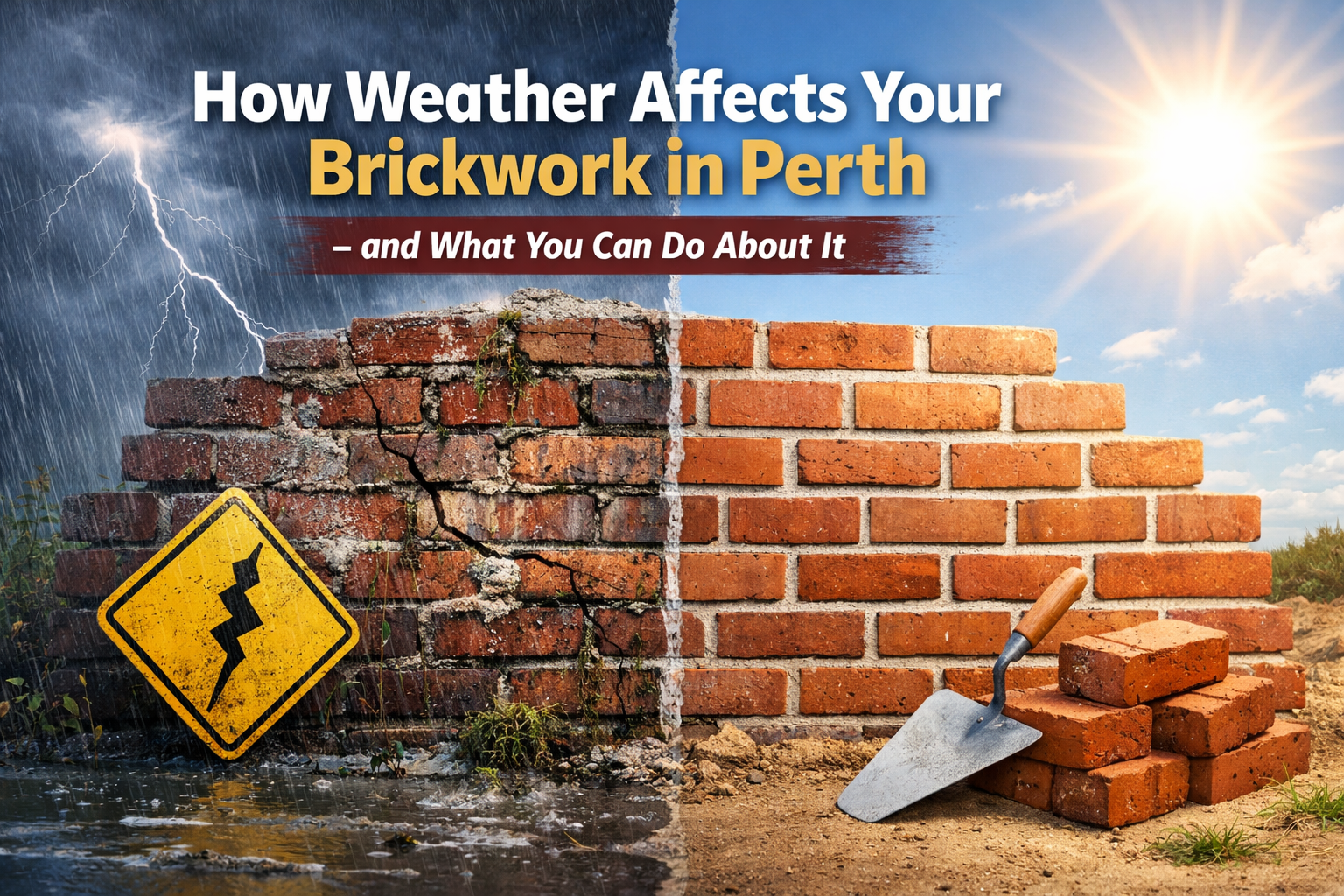
Walk around almost any Perth suburb and you’ll see the evidence: white chalky stains creeping across garden walls, crumbling mortar joints on older facades, retaining walls with hairline cracks running through them at odd angles. Most homeowners assume this is just normal ageing. It isn’t. It’s weather damage — and Perth’s climate is one of the most demanding on brickwork of any capital city in Australia.
Perth’s brickwork quietly battles dust storms, salty coastal breezes, aggressive UV rays, and occasional winter drenching — often in the same week. That combination of extremes is uniquely destructive, and understanding exactly what’s happening to your bricks is the first step to stopping the damage before it becomes structural.
Experienced Perth bricklayers consistently identify the same four weather-related culprits behind brickwork deterioration across the metropolitan area — and each one has a practical solution. Here’s what to know.
The 4 Ways Perth’s Weather Is Damaging Your Brickwork Right Now
1. Intense UV Radiation and Extreme Summer Heat
Perth’s summers are relentless. Perth’s mean maximum daily temperature hits 31.6°C with severe heatwave conditions recorded across Greater Perth, and the UV index regularly reaches extreme levels throughout summer months.
For brickwork, that prolonged UV exposure creates a specific and progressive pattern of damage:
Constant exposure to sunlight causes expansion during the heat of the day and contraction as temperatures drop overnight — this continuous cycle weakens materials gradually. UV rays erode the mortar that holds bricks together, and regular inspections and timely repairs prevent long-term damage.
Prolonged sun exposure dries out brick faces and causes gradual colour fading — most noticeable on south and west-facing walls that receive the most direct sun. UV radiation also breaks down the organic binders in some mortar formulations, contributing to surface hardening and cracking.
What you can do:
- Apply a UV-resistant breathable sealant to sun-exposed elevations — particularly north and west-facing walls which take the heaviest UV load in Perth
- Choose lighter-coloured bricks and reflective materials for new work — deep charcoal bricks absorb too much heat during summer months, affecting both the brickwork’s longevity and interior temperatures
- Inspect mortar joints annually after summer — UV-degraded mortar crumbles visibly and needs addressing before water can penetrate
2. Coastal Salt Air — Perth’s Hidden Brickwork Destroyer
Houses within three kilometres of the ocean experience significant salt damage — including lime mortar erosion in brickwork and corrosion of structural elements. This affects a substantial portion of Perth’s residential areas across the coastal corridor from Two Rocks to Rockingham.
When salt-laden moisture penetrates bricks, it leads to salt efflorescence and, over time, corrodes both the bricks and mortar. Efflorescence appears as white powdery stains on brick surfaces — caused when water moves through brick and mortar, dissolves salts within the materials, and deposits crystallised salt as it evaporates on the surface.
Left untreated, efflorescence is more than cosmetic. The crystallisation process physically forces itself into the brick’s pore structure, widening microfractures with each wet-dry cycle.
What you can do:
- Brush off efflorescence with a dry stiff brush during dry weather — never when wet, which pushes salts deeper into the brick
- For coastal Perth suburbs (Cottesloe, Scarborough, Fremantle, Rockingham), apply salt-resistant protective coatings designed specifically for marine environments
- Ensure adequate drainage around brick walls so salt-laden water doesn’t pool against the structure and penetrate repeatedly
3. Perth’s Winter Rain — The Moisture Problem Inside Your Walls
Perth’s brick walls face the occasional winter drenching — and when water infiltrates brickwork, it dissolves internal salts and carries them to the surface, accelerating mortar decay and brick face deterioration simultaneously.
Perth’s Mediterranean climate concentrates almost 70% of its annual rainfall between May and August. That concentrated wet season creates specific patterns of moisture damage:
- Mortar joint cracking — Water enters through deteriorated joints, expands slightly as it sits in porous material, and works the crack wider with each rain event
- Vanadium staining — Light-coloured bricks contain a salt called Vanadium — when exposed to acidic rainwater, these salts turn yellow, creating an unsightly stain that’s visible for the lifetime of the brick if not treated promptly.
- Discoloured mortar — Water that penetrates mortar during laying or after joint deterioration causes visible colour inconsistencies across the brickwork face
What you can do:
- Inspect mortar joints every autumn before winter rain arrives — cracked or recessed joints need repointing before June
- Apply a breathable waterproofing sealant to external brickwork — waterproof but breathable is critical, as the ability to release internally trapped moisture is as important as resisting new moisture entry .
- Ensure gutters and downpipes discharge water well away from brick walls — the sustained moisture contact from failed gutters is one of the most common causes of accelerated brickwork deterioration across Perth
4. Thermal Cycling and Soil Movement — The Slow Structural Threat
Beyond surface damage, Perth’s hot-dry summers followed by wet winters create a soil moisture cycle that moves the ground beneath brick structures. This is particularly damaging to free-standing garden walls, boundary walls, and retaining structures.
Temperature fluctuations cause bricks to expand and contract continuously — in regions with significant seasonal temperature variations, this constant cycle creates fractures and structural flaws in brickwork. Extreme heat can dry out and weaken mortar while sudden temperature changes cause brittle fractures.
Perth’s reactive clay soils in the eastern and southern suburbs amplify this effect — the soil literally swells and contracts with moisture changes, putting horizontal stress on brick foundations and bases.
This is where experienced retaining wall builders become critical. A retaining wall that was constructed without adequate drainage, correct footing depth, or appropriate reinforcement for Perth’s soil conditions will show the evidence of thermal cycling and soil movement as diagonal cracking through mortar joints — the classic sign of differential movement.
What you can do:
- Monitor retaining walls and boundary walls annually for diagonal or stepped cracking — these patterns indicate movement, not just surface deterioration
- Ensure weep holes in retaining walls are clear — blocked weep holes allow hydrostatic pressure to build and push the wall face outward.
- Don’t ignore movement cracks — they widen with every seasonal cycle and what starts as a 2mm crack becomes a 10mm structural problem within a few winters
Warning Signs Your Perth Brickwork Needs Attention Now
Not every crack is structural. Not every white stain is urgent. But these specific warning signs indicate that action is needed before weather damage progresses:
- Stepped or diagonal cracks in mortar joints — indicates movement, particularly concerning on retaining and boundary walls
- Recessed or crumbling mortar joints — mortar that has eroded back from the brick face allows water direct entry into the wall
- White powdery deposits (efflorescence) — present on multiple areas simultaneously indicates persistent moisture movement through the structure
- Spalling bricks — where the brick face is flaking or breaking away, usually caused by moisture penetration combined with thermal cycling
- Bulging or bowing sections — a serious structural warning sign requiring immediate professional assessment
Practical Maintenance Calendar for Perth Homeowners
Protecting your brickwork against Perth’s weather doesn’t require constant vigilance — just timely action at the right points in the season:
| Season | Action |
|---|---|
| Autumn (Mar–May) — Now | Inspect mortar joints, clear weep holes, apply sealants before winter rain, remove any efflorescence deposits |
| Winter (Jun–Aug) | Monitor for new cracking after rain events, check drainage is diverting water away from brick structures |
| Spring (Sep–Nov) | Post-winter inspection, repoint any newly deteriorated mortar, assess salt damage on coastal-facing walls |
| Summer (Dec–Feb) | Check UV-exposed elevations for mortar cracking, apply UV-resistant coatings before peak heat season |
Practical tip: A UV-resistant sealant provides meaningful protection against fading and mortar UV degradation on sun-exposed wall faces — and regular repointing keeps mortar joints performing despite the combined effects of UV exposure and thermal cycling throughout the year.
When DIY Maintenance Stops Being Enough
Surface cleaning, efflorescence brushing, and applying sealants are legitimate DIY tasks for most Perth homeowners. But some damage requires professional assessment and repair before weather makes it significantly worse.
If you’re seeing structural cracking, multiple spalling bricks, or mortar that has recessed 10mm or more from the brick face across a significant wall section, professional brick repairing Perth services are the right next step — not because the work is necessarily complex, but because the underlying cause needs to be correctly identified before any surface repair is made.
Repointing over active movement cracks without addressing the cause just means redoing the repoint in 12 months. Sealing over saturated brickwork traps moisture and accelerates the damage it was meant to prevent. Getting the diagnosis right saves money and protects the structural integrity of your home.
Conclusion — Perth’s Weather Works on Your Brickwork Every Single Day
The UV, the salt air, the winter rain, and the reactive soil beneath your foundations don’t take a season off. But neither do the effects — they build incrementally, and the homes that look their best and hold their value longest in Perth are the ones where small problems are caught and addressed before they become expensive structural issues.
Autumn is genuinely the best window to act. The summer damage is visible, the rain season hasn’t arrived yet, and the conditions are ideal for sealants, repointing, and protective coatings to cure properly.