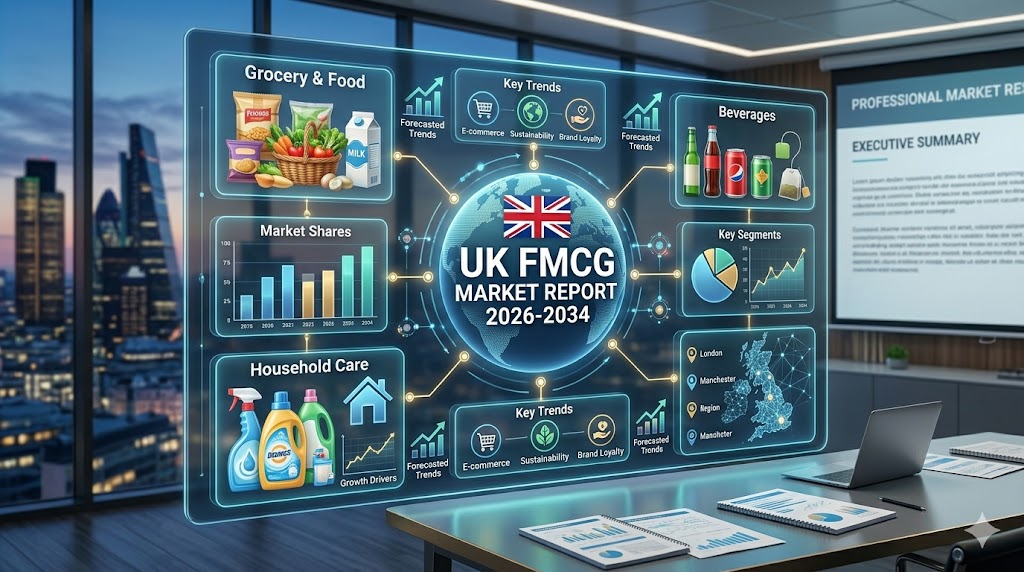
The United Kingdom’s consumer goods sector is undergoing a profound transformation. What was once a market defined by the weekly “big shop” at a suburban hypermarket has evolved into a high-tech, multi-channel ecosystem where convenience, sustainability, and digital integration reign supreme. As of 2025, the UK FMCG market reached a valuation of USD 266.2 Billion, and it shows no signs of slowing down.
With a projected compound annual growth rate (CAGR) of 4.64% the market is expected to reach USD 405.3 Billion by 2034. These figures represent more than just economic recovery; they signal a fundamental shift in how British consumers interact with brands, technology, and the environment.
1. The Digital Revolution: Beyond the Webpage
The most significant catalyst for change in 2026 is the maturity of digital retail. We have moved past the “online transition” into an era of Digital Reinvention.
- AI-Powered Personalization: Major retailers are no longer just listing products; they are deploying Agentic AI that plans, acts, and learns. In 2026, roughly 35% of UK consumers use AI to assist their shopping – a nearly 40% jump year-on-year. These systems build baskets, compare prices, and predict when a household will run out of essentials.
- The Rise of “Shoppertainment”: Platforms like TikTok Shop saw a 55% sales increase in the UK by late 2025. Shopping is becoming an experience integrated into social media, where discovery and transaction happen seamlessly within minutes.
- Hyper-Local Fulfillment: To meet the demand for near-instant delivery, physical stores are being repurposed into micro-fulfillment hubs. Retailers like Tesco and Sainsbury’s are leveraging their brick-and-mortar footprint to power last-mile logistics, turning every local supermarket into a high-speed distribution center.
2. The Ethical Consumer: Sustainability as a Compliance Standard
In 2026, sustainability has shifted from a “marketing differentiator” to a commercial requirement.
- Embedded Sustainability: Consumers now expect eco-friendly practices – such as recyclable packaging and carbon reduction – to be “embedded” in the product price rather than being a premium add-on.
- The Green Claims Code: Regulators, such as the CMA, are using AI to scan millions of ads for “greenwashing.” Retailers now face fines of up to 10% of global turnover for misleading environmental claims, forcing a move toward radical transparency and verifiable provenance.
- Regenerative Sourcing: “Provenance” is the new shorthand for sustainability. Consumers are increasingly seeking products with a traceable supply chain, often linked to specific British regions or named farms, as seen in the rising demand for organic and locally sourced produce.
3. The Strategy of Value: The Private Label “Golden Age”
With lingering economic pressures, the British shopper has become “value loyal” rather than brand loyal. This has triggered a massive expansion in Private Label (Store Brand) Products.
- Strategic Advantage: Private labels now account for over 52% of UK grocery sales. Retailers are investing heavily in “Premium” own-label ranges that cater to at-home dining experiences, with some lines seeing growth of up to 15%.
- Quality over Price: The stigma of the “budget” brand has vanished. Research shows 58% of consumers believe store-brand quality now matches or exceeds that of major national brands.
- Digital Trust Gap: Despite their popularity, private labels often lack the extensive online review history of national brands. Retailers in 2026 are focusing on building “Digital Trust” by encouraging user-generated content for their own-label lines to bridge this conversion gap.
Sample Request For Your Business Report
4. Market Segmentation: Where the Growth Lies
The UK market is diverse, and understanding its segments is key to identifying long-term opportunities.
By Product Type
- Food and Beverages: This remains the largest segment, valued at over USD 205 Billion. The focus is on health-centric, “clean-label,” and plant-based innovations.
- Personal Care and Cosmetics: One of the fastest-growing categories, driven by a post-pandemic surge in wellness and “self-care” rituals.
- Home Care & Footwear: Steady segments that are seeing a shift toward sustainable materials and bio-degradable cleaning solutions.
By Distribution Channel
| Channel | 2026 Outlook | Key Driver |
| Hypermarkets | Dominant but evolving | Repurposing space for fulfillment |
| Convenience Stores | Rapid Growth | Urbanization and “top-up” shopping |
| E-Commerce | 18.5% CAGR | Mobile-first apps and AI-driven UI |
| Discount Stores | Expanding | Price sensitivity and premium private labels |
5. Recent Industry Movements: Battle for Market Share
The competitive landscape is more aggressive than ever. Recent headlines highlight the strategic land grab currently taking place:
- Asda’s Convenience Push: In 2025-2026, Asda accelerated its mission to become the UK’s second-largest supermarket by rapidly rebranding outlets acquired from Co-op and EG Group into its “Asda Express” format.
- Tesco’s Market Dominance: Tesco continues to hold a 28% market share, bolstered by a 5.1% rise in like-for-like sales through its focus on loyalty-driven “Clubcard Prices” and enhanced online service.
- Aldi’s Expansion: Having hit record growth, Aldi is doubling down on London, aiming to open dozens of new stores to capture the high-density urban market.
6. Navigating Risks: Cybersecurity and Supply Chains
The move toward a digital-first market brings new vulnerabilities.
- Cyber Resilience: Following high-profile breaches (such as the M&S cyber attack in 2025 which caused a £30 million profit loss), 85% of UK organizations have increased their cyber budgets for 2026. “Zero-trust” security is now the industry standard for protecting consumer data.
- Supply Chain Visibility: To maintain consumer trust, retailers are investing in blockchain-based tracking and AI-enabled demand forecasting to prevent stockouts and ensure food safety compliance.
Conclusion: The Path Forward
The UK FMCG and grocery market in 2026 is a balancing act. Success requires retailers to be high-tech enough to offer seamless AI-driven experiences, yet grounded enough to provide authentic, sustainable, and value-driven products. The winners of the next decade will be those who treat sustainability not as a compliance task, but as a core strategic driver.