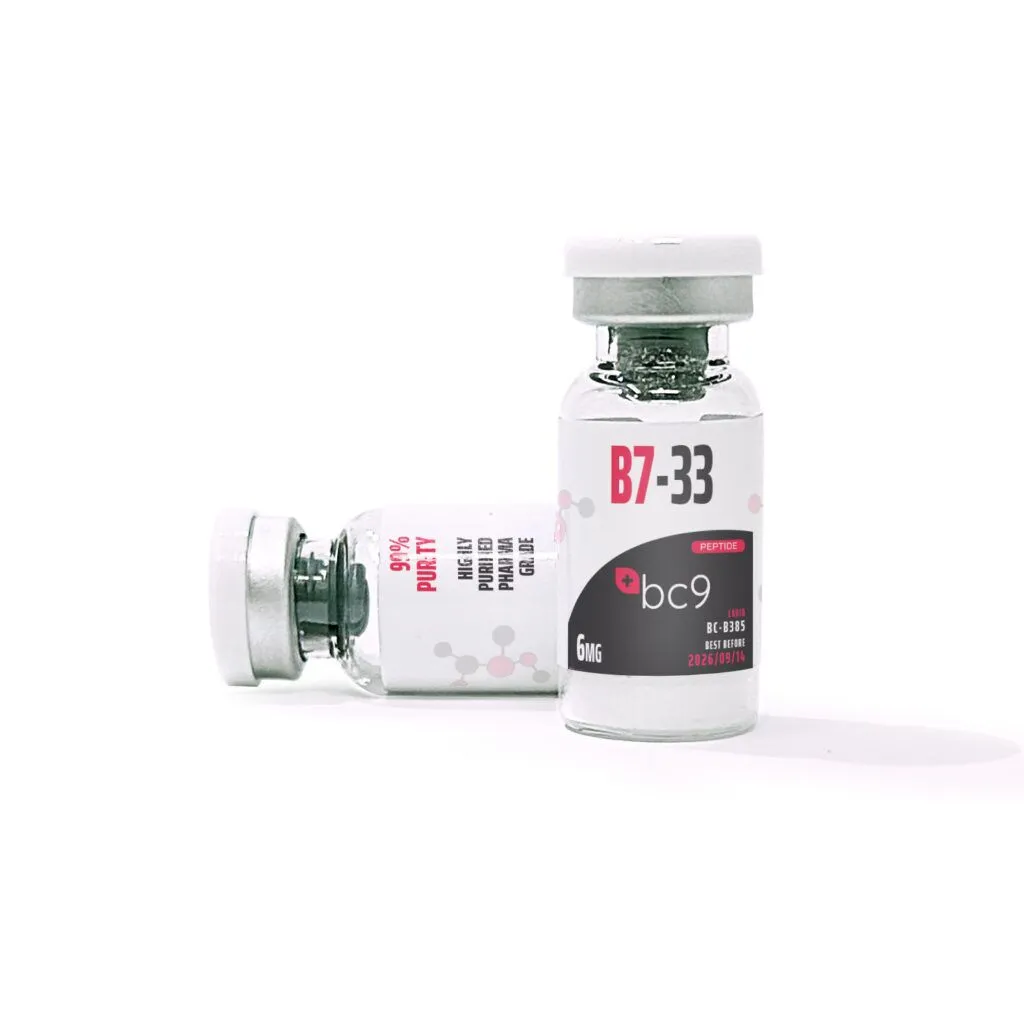
B7-33 is a synthetically engineered relaxin-2 analog designed to preserve beneficial receptor signaling while minimizing pro-fibrotic activity observed with full-length relaxin. By selectively engaging RXFP1-mediated pathways, B7-33 has become a focal point in contemporary research exploring tissue remodeling, vascular biology, and anti-fibrotic signaling without excessive extracellular matrix deposition.
Molecular Design and Receptor Selectivity
B7-33 is derived from the B-chain of human relaxin-2, modified to retain high-affinity interaction with the RXFP1 receptor while attenuating downstream cascades associated with fibrosis. Unlike native relaxin, which activates a broader signaling spectrum, B7-33 demonstrates biased agonism favoring cAMP-dependent pathways and limiting ERK1/2 overactivation linked to collagen synthesis.
Key molecular attributes
- Truncated peptide architecture optimized for RXFP1 engagement
- Reduced activation of TGF-β–driven fibrotic signaling
- Enhanced stability in controlled laboratory environments
- Predictable receptor pharmacodynamics for reproducible experimentation
RXFP1 Signaling Pathways Activated by B7-33
Upon binding to RXFP1, B7-33 initiates intracellular signaling that supports vasorelaxation, nitric oxide modulation, and anti-inflammatory responses. Importantly, this activation profile avoids excessive fibroblast proliferation, positioning B7-33 as a non-fibrotic relaxin analog of high experimental value.
Anti-Fibrotic Research Implications
Fibrosis remains a central challenge across cardiovascular, renal, pulmonary, and hepatic research models. Traditional relaxin compounds have shown promise but carry a risk of stimulating fibrotic remodeling under certain conditions. B7-33 addresses this limitation by selectively decoupling beneficial relaxin signaling from collagen-promoting pathways.
Research domains of interest
- Cardiac remodeling and myocardial compliance studies
- Renal interstitial fibrosis models
- Pulmonary tissue elasticity research
- Connective tissue and extracellular matrix regulation
Vascular and Hemodynamic Research Applications
B7-33’s ability to influence nitric oxide signaling and smooth muscle relaxation has made it particularly valuable in vascular research. Studies frequently explore its role in endothelial function, arterial compliance, and microcirculatory dynamics without the confounding variable of fibrotic tissue response.
Observed experimental advantages include:
- Controlled vasodilatory response
- Improved endothelial signaling clarity
- Reduced long-term tissue remodeling artifacts
Comparative Advantages Over Native Relaxin
When evaluated against full-length relaxin-2, B7-33 offers a refined signaling profile better suited for mechanistic studies.
| Parameter | Relaxin-2 | B7-33 |
| RXFP1 Activation | Broad | Selective |
| Fibrotic Risk | Moderate | Minimal |
| Signaling Bias | Mixed | cAMP-favored |
| Research Precision | Variable | High |
Stability, Handling, and Research Integration
B7-33 is commonly supplied as a lyophilized research compound, supporting long-term storage and experimental consistency. Its structural simplicity relative to full-length relaxin facilitates integration into in-vitro and in-vivo research protocols where controlled receptor engagement is essential.
Researchers value B7-33 for:
- Batch-to-batch consistency
- Predictable degradation kinetics
- Compatibility with receptor binding assays
Market Interest and Availability
As demand grows for selective, non-fibrotic relaxin analogs, interest in b7-33 for sale has increased across academic and private research sectors. Procurement decisions are typically guided by purity verification, analytical documentation, and adherence to research-only distribution standards.
Future Directions in Relaxin Analog Research
B7-33 represents a shift toward precision peptide design where signaling outcomes are intentionally biased to enhance experimental clarity. Ongoing investigations continue to explore its role as a scaffold for next-generation RXFP1 agonists with even greater selectivity and functional specificity.
Summary
B7-33 stands out as a non-fibrotic relaxin analog engineered for high-fidelity RXFP1 signaling. Its selective molecular design, reduced fibrotic risk, and broad applicability across vascular and tissue remodeling research make it a cornerstone compound in modern relaxin studies. As interest in targeted peptide signaling expands, B7-33 remains a benchmark for precision-driven relaxin analog development.