Fuel delivery apps are transforming how individuals and businesses access fuel by eliminating the need to visit physical fuel stations. Instead, fuel is delivered directly to the customer’s location, whether that is a residential area, construction site, logistics hub, or corporate parking facility. This model addresses major pain points such as time wastage, long queues, inconsistent fuel availability, and inefficiencies in fleet refueling operations.
The growing demand for on-demand services, rapid urbanization, expansion of logistics and mobility businesses, and increasing smartphone penetration have made fuel delivery apps a strong market opportunity. For startups and enterprises alike, investing in this space allows entry into a high-utility service market with repeat usage potential, subscription-based revenue models, and strong B2B demand.
An end-to-end approach to fuel delivery app development ensures regulatory compliance, operational efficiency, user safety, and scalability from day one.
Defining the Business Model and Target Audience
Before starting development, it is critical to define the business model clearly. Fuel delivery platforms generally operate under B2C, B2B, or hybrid models.
In a B2C model, fuel is delivered to individual vehicle owners at homes or workplaces. This model focuses heavily on convenience, location accuracy, and fast delivery. In a B2B model, the platform caters to fleet operators, construction companies, mining operations, and logistics providers who need bulk fuel delivery and scheduled refueling. A hybrid model combines both approaches to maximize market reach.
Revenue streams typically include per-liter margins, delivery fees, subscription plans for frequent users, enterprise contracts, surge pricing during peak demand, and value-added services such as fuel quality certification or analytics dashboards for fleet managers.
Understanding the target audience helps determine feature priorities, pricing structures, and scalability requirements during Gas Delivery App Development.
Regulatory Compliance, Licensing, and Safety Considerations
Fuel delivery is a highly regulated industry. Any successful app must be built with compliance and safety at its core. Regulations vary by country and region, but generally include fuel transportation licenses, hazardous material handling approvals, vehicle certifications, driver training standards, and digital transaction compliance.
The app must support documentation uploads, license verification workflows, and compliance audits. Safety features such as emergency shutdown protocols, real-time monitoring of fuel tankers, and strict delivery verification processes are essential.
A professional Fuel Delivery App Development Company typically collaborates with legal advisors and industry experts to embed compliance requirements directly into the platform architecture, reducing operational risk after launch.
Core Features Required for Fuel Delivery Apps
A robust fuel delivery solution usually consists of multiple interconnected applications and dashboards.
The customer app enables users to register, select fuel type, choose quantity, set delivery location, schedule delivery time, track orders in real time, and make secure payments. It should also provide invoices, order history, and customer support access.
The delivery partner or driver app focuses on route optimization, order assignment, navigation, delivery confirmation, and safety checklists. GPS tracking and fuel dispensing verification are critical components.
The admin panel acts as the operational backbone. It allows administrators to manage users, pricing, inventory, delivery zones, driver performance, compliance records, and analytics. Advanced reporting tools help monitor demand trends, revenue, and operational efficiency.
These features must be carefully designed and integrated during Gas Delivery App Development to ensure smooth coordination between users, drivers, and operations teams.
Technology Stack and Architecture Planning
Selecting the right technology stack determines the app’s performance, scalability, and security. Mobile apps are commonly built using native technologies or cross-platform frameworks, while the backend requires a scalable cloud-based infrastructure.
Key considerations include real-time GPS tracking, high-availability servers, secure payment gateways, role-based access control, and data encryption. The architecture should support peak demand without performance degradation and allow future integration with IoT devices such as smart fuel meters or vehicle sensors.
Microservices architecture is often preferred, as it allows independent scaling of modules such as payments, order management, and tracking services. This approach reduces downtime and simplifies future upgrades.
User Experience and Interface Design Strategy
User trust is essential in fuel delivery services. The app interface must be simple, intuitive, and transparent. Clear pricing breakdowns, accurate delivery timelines, and visible safety assurances help build confidence.
For customers, minimal steps to place an order, accurate location selection, and real-time notifications improve usability. For drivers, distraction-free navigation and simplified delivery workflows reduce errors and delays. For admins, dashboards should present actionable insights without overwhelming complexity.
Investing in UX research and usability testing early in the development process significantly improves adoption and retention rates after launch.
Development Process and Quality Assurance
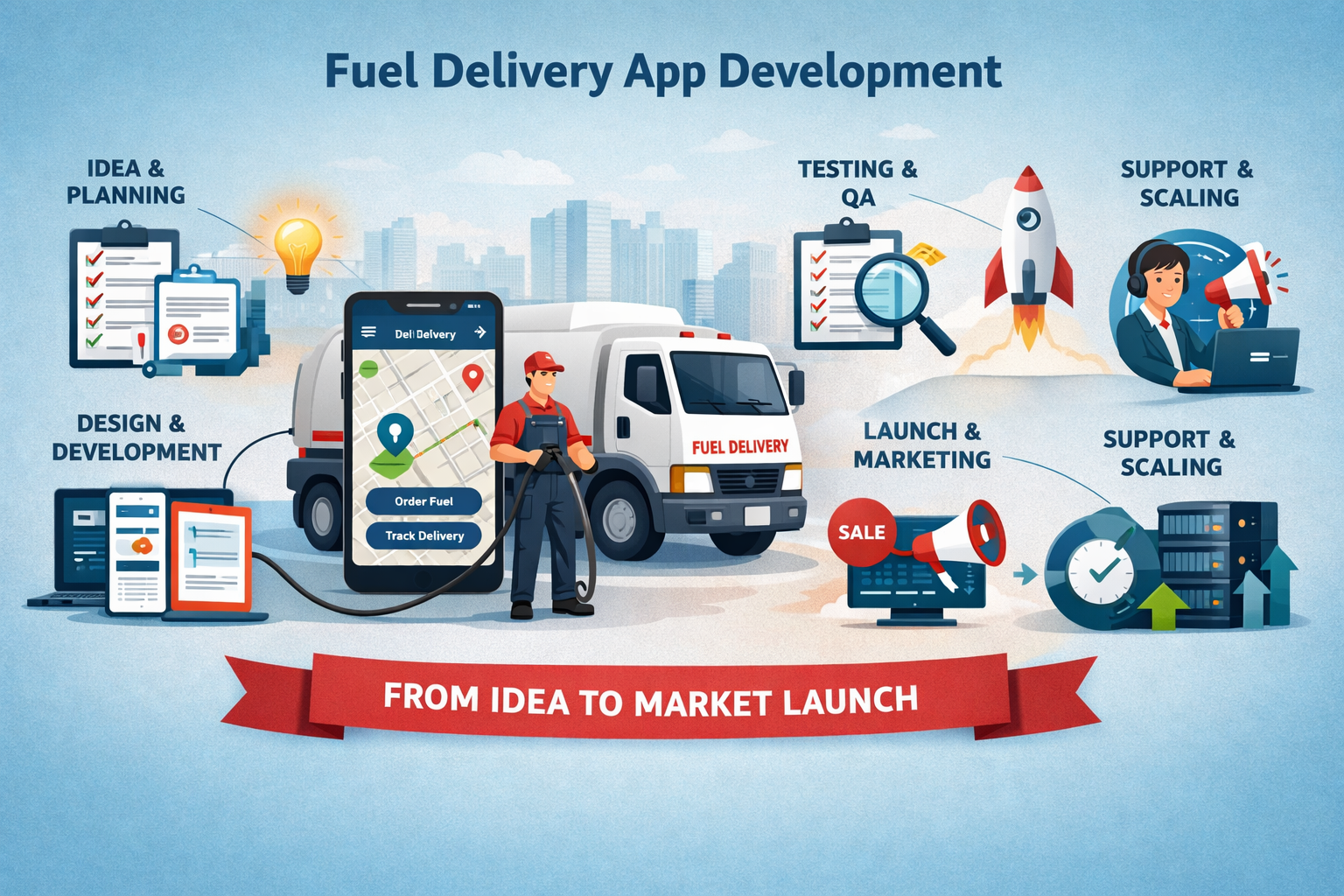
End-to-end development typically follows a structured lifecycle starting with requirement analysis and wireframing, followed by UI design, backend and frontend development, integration, and testing.
Quality assurance is especially critical for fuel delivery apps due to safety and financial implications. Testing should cover functional workflows, payment security, location accuracy, performance under load, and failure recovery scenarios. Compliance testing ensures that regulatory requirements are met across regions.
A reliable Fuel Delivery App Development Company emphasizes iterative testing and continuous feedback to eliminate risks before deployment.
Deployment, Scaling, and Market Launch Strategy
Once development and testing are complete, the app is deployed on cloud infrastructure and published to relevant app stores. A phased launch strategy is often recommended, starting with a limited geographic area to validate operations and gather real-world feedback.
Marketing strategies may include partnerships with fleet operators, digital advertising, referral programs, and corporate onboarding campaigns. Operational readiness, including trained drivers, fuel supply chains, and customer support teams, is just as important as technical readiness.
Scalability planning ensures the platform can expand into new regions, support additional fuel types, and handle growing transaction volumes without major reengineering.
Post-Launch Support, Maintenance, and Future Enhancements
Launching the app is only the beginning. Continuous monitoring, performance optimization, and feature enhancements are necessary to stay competitive. Regular updates address security vulnerabilities, regulatory changes, and evolving user expectations.
Future enhancements may include AI-based demand forecasting, dynamic pricing engines, IoT-enabled fuel dispensing verification, loyalty programs, and advanced analytics for enterprise clients.
Ongoing support ensures long-term reliability and helps the platform adapt to market shifts.
Conclusion
End-to-end fuel delivery app development requires far more than basic app creation. It involves strategic planning, regulatory compliance, robust technology architecture, safety-first design, and scalable operations. By carefully defining the business model, building feature-rich applications, and executing a structured launch strategy, businesses can successfully enter and grow in the on-demand fuel delivery market. Partnering with an experienced Fuel Delivery App Development Company significantly reduces risk and accelerates time to market while ensuring compliance and performance at scale.
FAQs
What is the typical timeline for fuel delivery app development?
The development timeline usually ranges from four to eight months, depending on feature complexity, regulatory requirements, integrations, and testing depth.
Is fuel delivery app development legally permitted in all regions?
No, regulations vary by country and state. Businesses must obtain necessary licenses and approvals before operating. Compliance requirements should be evaluated early in the development phase.
How does Gas Delivery App Development ensure fuel quality and safety?
Quality and safety are ensured through certified suppliers, compliant delivery vehicles, trained drivers, real-time monitoring, and digital verification of delivery processes.
Can a fuel delivery app support both individual users and enterprises?
Yes, a well-designed platform can support both B2C and B2B users with different pricing models, delivery workflows, and analytics features.
What ongoing costs should be expected after launch?
Post-launch costs include cloud hosting, maintenance, security updates, customer support, regulatory compliance updates, and feature enhancements based on user feedback.