United States Epoxy Resin Market Size and Forecast 2026–2034
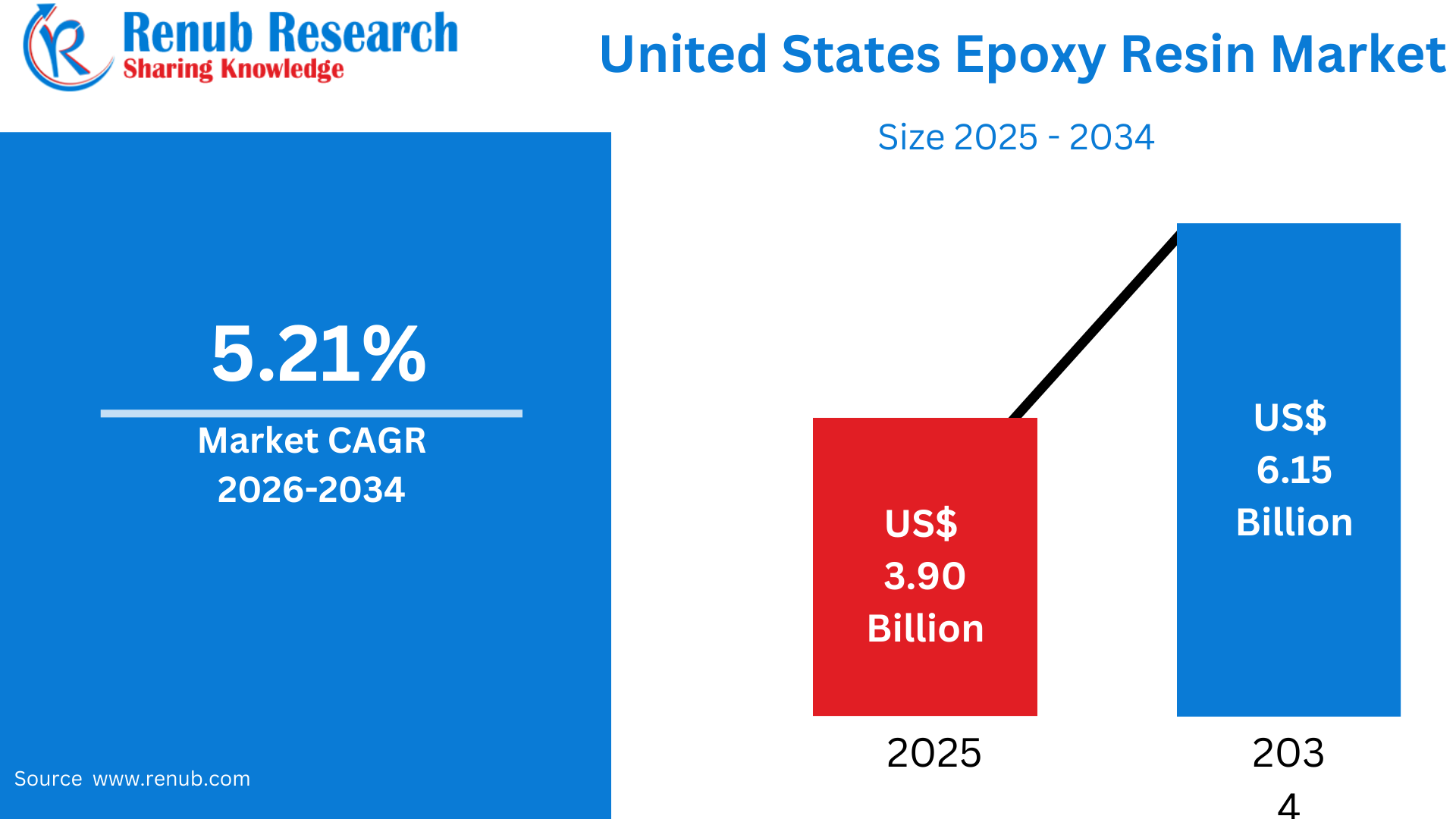
According to Renub Research United States epoxy resin market is projected to demonstrate steady and resilient growth over the forecast period. The market is expected to expand from US$ 3.90 billion in 2025 to approximately US$ 6.15 billion by 2034, registering a compound annual growth rate (CAGR) of 5.21% from 2026 to 2034. This growth is driven by rising demand from key end-use sectors such as construction, automotive, aerospace, electronics, marine, and renewable energy.
Epoxy resins continue to gain preference due to their superior mechanical strength, chemical resistance, adhesion, and thermal stability. Increasing infrastructure modernization, growing adoption of lightweight composite materials, and expansion of wind energy and electric vehicle production are strengthening long-term demand. Additionally, innovation in resin chemistry, including low-VOC and high-performance epoxy systems, is further enhancing market penetration across industrial and consumer applications in the United States.
Download Free Sample Report:https://www.renub.com/request-sample-page.php?gturl=united-states-epoxy-resin-market-p.php
United States Epoxy Resin Market Outlook
Epoxy resin represents a broad family of thermosetting polymers produced through the reaction of epoxide groups with curing agents such as amines, anhydrides, or phenols. Once cured, epoxy resins form a rigid, cross-linked structure that delivers excellent durability, dimensional stability, and resistance to chemicals, moisture, and heat.
In the United States, epoxy resins are widely used in building and construction, aerospace, automotive, electrical and electronics, marine, and consumer goods industries. Their strong bonding capability with metals, concrete, wood, and fiber-reinforced composites makes them indispensable in coatings, adhesives, laminates, encapsulation systems, flooring, and structural repair applications.
Epoxy resins have gained strong acceptance in the U.S. market due to their reliability and adaptability in advanced material applications. Lightweight epoxy composites are increasingly used in automotive and aerospace manufacturing to improve fuel efficiency and performance. Epoxy coatings are critical for protecting pipelines, industrial equipment, and infrastructure from corrosion and mechanical wear. At the consumer level, epoxy is widely used in home improvement, DIY crafts, countertops, flooring, and waterproofing solutions. Furthermore, the rapid expansion of renewable energy—particularly wind turbine blade manufacturing—continues to reinforce epoxy resin adoption. Supported by strong industrial growth and continuous innovation, epoxy resin remains a foundational material across U.S. manufacturing and engineering sectors.
Growth Drivers in the United States Epoxy Resin Market
Increasing Demand for High-Performance Materials Across Industrial Sectors
A major growth driver for the U.S. epoxy resin market is the rising requirement for high-performance materials across construction, automotive, aerospace, marine, and electronics industries. Epoxy resins offer superior adhesion, mechanical strength, and corrosion resistance, making them essential for structural bonding, protective coatings, composite materials, and flooring systems.
As industries increasingly shift toward durable, lightweight, and energy-efficient materials, epoxy-based composites are being adopted at a rapid pace. Infrastructure modernization projects involving highways, bridges, industrial plants, and commercial buildings are fueling demand for epoxy coatings, repair compounds, and adhesives. In automotive and aerospace manufacturing, epoxy resins enable the development of lightweight components that enhance fuel efficiency, structural integrity, and safety.
Strategic investments and capacity expansions further highlight market confidence. In June 2025, Aditya Birla Group Chemicals expanded its U.S. footprint through the acquisition of a specialty chemical manufacturing facility in Georgia, strengthening domestic epoxy resin production capabilities.
Growth in Construction, Coatings, and Infrastructure Upgrades
The United States continues to invest heavily in public and private infrastructure development, industrial refurbishment, and commercial construction. Epoxy resins play a critical role in these activities due to their durability, chemical resistance, and strong adhesive properties.
Epoxy coatings are widely used to protect concrete floors, steel structures, pipelines, and storage tanks from corrosion, abrasion, and harsh environmental exposure. The increasing focus on sustainability has accelerated the shift toward low-VOC and environmentally compliant epoxy formulations. Decorative epoxy flooring has also gained popularity in residential and commercial spaces, offering long service life, reduced maintenance, and enhanced aesthetics.
In 2025, regional service providers expanded epoxy flooring offerings to meet rising demand for functional and visually appealing surfaces in residential and commercial buildings, reflecting broader market momentum.
Expanding Use of Composite Materials in Automotive and Aerospace
The growing adoption of advanced composite materials in U.S. automotive and aerospace industries is a significant driver of epoxy resin consumption. Epoxy-based composites provide high strength-to-weight ratios, excellent fatigue resistance, and thermal stability, making them suitable for aerospace structures, electric vehicle battery systems, interior panels, and lightweight automotive components.
Epoxy resins play a vital role in electric vehicle applications, including battery encapsulation, insulation, and thermal management systems, as EV production continues to accelerate nationwide. In aerospace manufacturing, epoxy composites are increasingly used in commercial, defense, and space applications to reduce weight, improve fuel efficiency, and enhance durability. In April 2024, Huntsman Corporation introduced a toughened epoxy resin system designed for high-pressure hydrogen storage tanks in fuel-cell vehicles, improving safety and lifespan.
Challenges in the United States Epoxy Resin Market
Volatility in Raw Material Prices and Supply Chain Pressures
One of the key challenges facing the U.S. epoxy resin market is volatility in raw material prices, particularly for petroleum-derived feedstocks such as bisphenol-A and epichlorohydrin. Fluctuations in crude oil prices, refinery capacity constraints, and geopolitical uncertainties create cost instability for manufacturers.
Global supply chain disruptions also affect the availability of curing agents, additives, and specialty chemicals. These challenges complicate long-term pricing strategies and pressure profit margins, especially for small and medium-sized manufacturers with limited sourcing flexibility.
Environmental Concerns and Regulatory Restrictions
Environmental sustainability concerns are increasingly influencing epoxy resin production and usage. Regulatory bodies in the United States are imposing stricter standards related to VOC emissions, chemical formulations, and workplace safety. Compliance often requires manufacturers to invest in cleaner technologies, product reformulation, and alternative raw materials, increasing operational costs.
Although consumer demand for eco-friendly and bio-based epoxy resins is growing, these alternatives often involve higher costs or performance limitations, slowing widespread adoption.
United States DGBEA Epoxy Resin Market
DGBEA epoxy resins represent the largest resin type segment in the U.S. market due to their balanced performance characteristics, including strong adhesion, chemical resistance, and versatility. These resins are widely used in coatings, adhesives, composites, and electrical encapsulation applications.
DGBEA resins are compatible with a wide range of curing agents, making them suitable for construction flooring, protective coatings, marine finishes, and automotive components. Their thermal stability and moisture resistance also support use in electronic potting and insulation applications. As demand for reliable thermosetting polymers continues to rise, DGBEA remains a preferred choice across U.S. industrial applications.
United States Aliphatic Epoxy Resin Market
The U.S. aliphatic epoxy resin market is growing steadily due to superior UV resistance, color stability, and weathering performance compared to aromatic epoxy systems. These properties make aliphatic epoxies ideal for applications exposed to sunlight and outdoor environments.
Common applications include clear coatings, decorative flooring, automotive refinishing, marine exteriors, and architectural surfaces. Although aliphatic epoxies are typically more expensive, their long-term performance and resistance to yellowing make them valuable in premium applications requiring durability and visual appeal.
United States Solid Epoxy Resin Market
Solid epoxy resins are widely used in powder coatings and high-durability industrial applications due to their excellent stability and long shelf life. Powder coatings based on solid epoxy resins provide superior abrasion resistance, chemical resistance, and adhesion, making them suitable for appliances, pipes, furniture, and automotive components.
In electrical and electronic applications, solid epoxy resins are used for laminates, circuit boards, and insulation materials. The growing shift toward solvent-free and environmentally friendly coating technologies is further driving demand for solid epoxy systems in the United States.
United States Epoxy Resin Paints and Coatings Market
Epoxy resin paints and coatings account for a significant share of total U.S. epoxy resin consumption. These coatings protect steel structures, concrete floors, pipelines, machinery, marine vessels, and storage tanks from corrosion and harsh environmental conditions.
Epoxy flooring systems are widely used in industrial facilities, hospitals, warehouses, and commercial buildings due to their durability, cleanability, and long service life. Infrastructure modernization projects, including bridge rehabilitation and water-treatment facility upgrades, continue to drive demand for epoxy coatings.
United States Epoxy Resin Electronic Encapsulation Market
Epoxy resins play a critical role in electronic encapsulation applications, protecting sensitive components from moisture, vibration, dust, and thermal stress. They are widely used in transformers, semiconductors, sensors, LED systems, automotive electronics, and renewable energy inverters.
The rapid growth of electric vehicle production has increased demand for epoxy potting compounds in battery systems and control units. High-purity epoxy materials are also increasingly used in semiconductor packaging and microelectronics manufacturing.
United States Epoxy Resin End-Use Industry Analysis
Building and Construction
Epoxy resins are essential in U.S. building and construction for flooring, adhesives, waterproofing, and structural repair. Their durability and low maintenance requirements make them ideal for industrial, commercial, and residential applications.
Consumer Goods
The consumer segment has experienced strong growth driven by DIY crafts, home décor, furniture, and customized products. Epoxy resins are widely used for river tables, jewelry, artwork, countertops, and garage flooring, supported by growing online tutorials and home renovation trends.
Aerospace
The aerospace sector is one of the largest consumers of epoxy resins in the U.S. Epoxy-based composites and adhesives support lightweight design, fuel efficiency, and structural integrity in aircraft and space applications.
State-Level Market Insights
California Epoxy Resin Market
California leads epoxy resin demand due to strong construction activity, electronics manufacturing, and sustainability initiatives.
New York Epoxy Resin Market
New York’s dense infrastructure and ongoing renovation projects sustain strong demand for epoxy coatings and flooring systems.
Washington Epoxy Resin Market
Washington benefits from aerospace, maritime, and advanced manufacturing activities, driving demand for high-performance epoxy formulations.
Arizona Epoxy Resin Market
Arizona’s fast-growing construction sector and harsh climate conditions support demand for durable epoxy coatings and flooring systems.
Competitive Landscape
The U.S. epoxy resin market is moderately consolidated, with global and regional players competing through innovation, capacity expansion, and sustainable product development. Key companies operating in the market include Atul Ltd., BASF SE, Chang Chun Group, Covestro AG, Daicel Corporation, DuPont de Nemours Inc., Hexion Holdings Corporation, Kukdo Chemicals Co. Ltd., and Olin Corporation.
Conclusion
The United States epoxy resin market is positioned for sustained growth through 2034, supported by infrastructure investment, advanced manufacturing, renewable energy expansion, and rising consumer applications. While challenges related to raw material volatility and environmental regulations persist, ongoing innovation and diversification of epoxy technologies are expected to drive long-term market resilience and opportunity.