
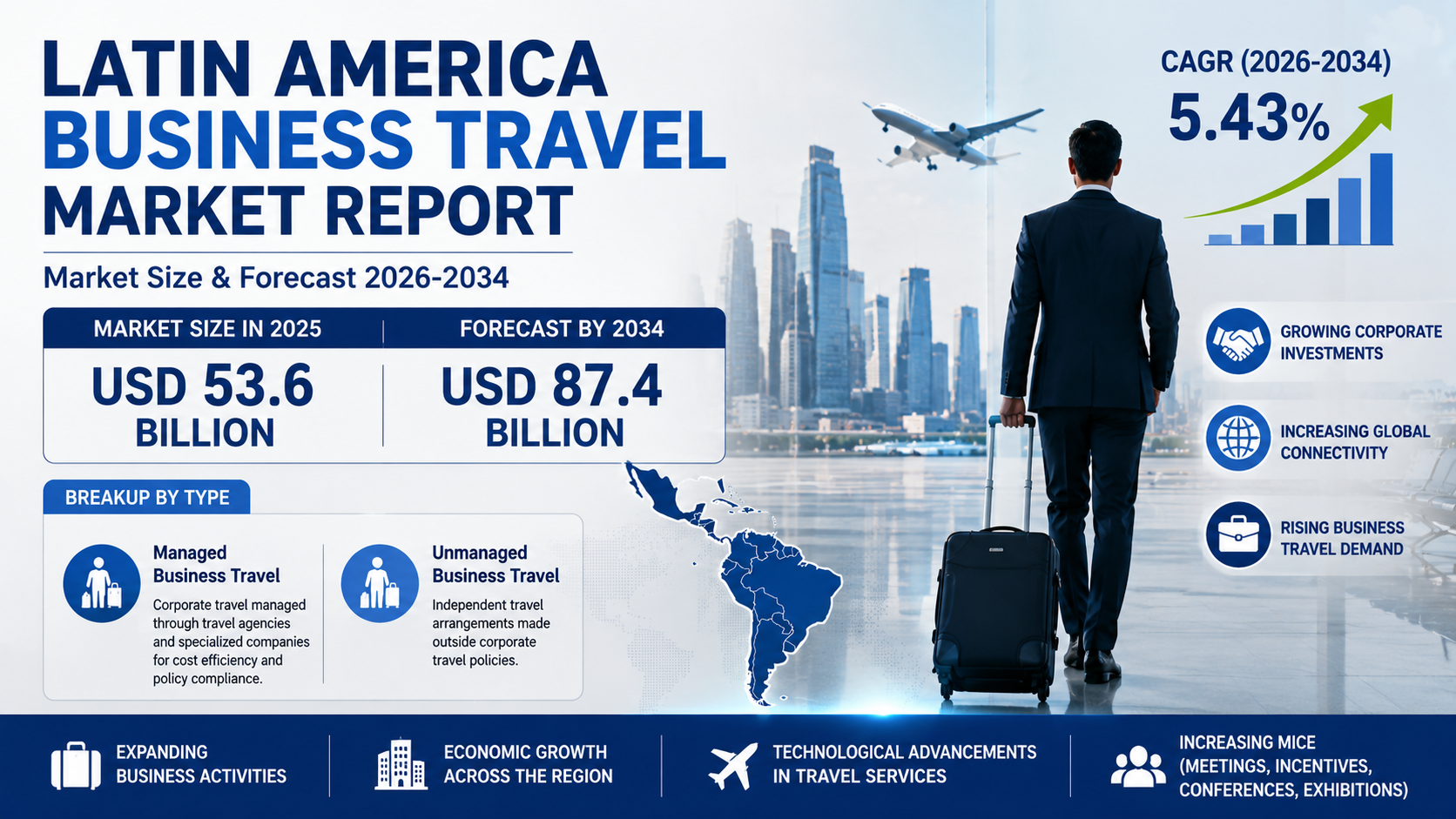
Business travel, commonly referred to as corporate travel, is a segment of the travel industry that involves domestic or international trips undertaken by employees and professionals for specific work-related purposes. These journeys are typically coordinated by internal travel departments or external service providers and are funded by the employer to facilitate activities such as client meetings, brand promotion, new market assessments, and project evaluations. In the context of the Latin America Business Travel Market, this sector has become a vital engine for regional globalization and economic integration. As of 2025, the market reached a valuation of USD 53.6 Billion, driven by a revitalized regional economy and the increasing necessity for face-to-face professional collaboration in a post-digital era.
What is the Market Forecast and Economic Growth Outlook for Corporate Travel Management Companies?
For Corporate Travel Management Companies (TMCs), the Latin America Business Travel Market represents a high-potential frontier for service expansion. The market is projected to reach USD 87.4 Billion by 2034, growing at a Compound Annual Growth Rate (CAGR) of 5.43% between 2026 and 2034.
TMCs are seeing a distinct shift in how organizations approach mobility. The market is currently bifurcated into Managed and Unmanaged Business Travel, with a significant trend toward managed services as companies seek to optimize their travel spend. Organizations are increasingly utilizing TMCs to oversee “Purpose-Driven” trips, which include:
- Marketing and Product Launches: Currently holding the largest share of the market, these trips are critical for companies expanding their footprint in emerging regional hubs.
- Internal Meetings and Trade Shows: Essential for maintaining organizational cohesion and industry visibility across the diverse Latin American landscape.
- Managed Efficiency: While unmanaged travel currently holds a significant portion of the market due to the flexibility it offers SMEs, TMCs are gaining ground by offering cost-efficient programs and policy compliance.
How Can Hotels & Hospitality Brands Adapt to the Rise of “Bleisure” and Food & Lodging Trends?
Hotels and Hospitality Brands are facing a new type of guest in Latin America: the “Bleisure” traveler. This emerging trend, which combines business and pleasure, allows executives to incorporate recreational activities into their work trips to relieve stress and enhance employee morale.
To capture this lucrative audience, hospitality providers must pivot their strategies:
- Dominance of Food and Lodging: This segment currently accounts for the largest market share in terms of service type. Professionals are looking for authentic dining experiences that reflect the region’s cultural diversity.
- Catering to Age Demographics: The market is divided between Travelers Below 40 Years (who lead in market share and prefer tech-integrated, social spaces) and Travelers Above 40 Years (who often prioritize traditional comfort).
- Solo and Group Travel Synergy: While Group Travel holds the largest share due to bulk-booking cost efficiencies for conferences, there is a steady rise in Solo Travel requiring personalized safety and efficiency.
- Strategic Regional Hubs: Major cities like São Paulo, Mexico City, and Buenos Aires attract travelers looking to blend meetings with local culture, requiring hotels to offer work-friendly amenities alongside leisure perks.
Why are Travel Technology Companies Prioritizing Automation and IoT Integration?
Travel Technology Companies are the architects of the modern corporate travel experience in Latin America. The surging penetration of the Internet of Things (IoT) and mobile applications is facilitating process automation and smoother operations for both travelers and operators.
Tech firms are currently focusing on the following to drive the Latin America Business Travel Market:
- Digitization of SMEs: Many small and medium enterprises currently use unmanaged travel. Tech providers are developing user-friendly platforms and mobile apps that empower individuals to manage itineraries independently while still capturing data for the company.
- Asset-Light and Tech-Driven Models: Innovations like those from Flix in Mexico highlight a move toward digitized, affordable travel options that modernize traditional transport networks.
- AI and Data-Driven Insights: Companies like Onfly are raising significant funding to boost AI capabilities, helping businesses track and manage travel expenses and itineraries with unprecedented precision.
- Inventory Expansion: Partners like Despegar.com and HBX Group are working to add diverse non-air inventory to platforms, broadening lodging and package options for B2B customers across the region.
Sample Request For Your Business
Which Regional Markets Offer the Best Opportunities for Business Travel Stakeholders?
The Latin America Business Travel Market is not a monolith; opportunities vary significantly by country based on industrial bases and infrastructure:
- Brazil: Exhibits clear dominance in the market, driven by a growing industrial base and its role as a regional business hub. São Paulo and Rio de Janeiro are magnets for international conferences and trade exhibitions.
- Mexico: Recently seeing an influx of investment from global players like TUI Group and Flix, focusing on modernizing bus travel and expanding tailored holiday experiences for local travelers.
- Colombia, Peru, Argentina, and Chile: These regions are seeing a surge in budget airline popularity and improved flight connectivity, making air-based Travel Fare the largest expenditure segment for regional business travel.
Conclusion:
The Latin America Business Travel Market is poised for a decade of significant transformation, evolving from a USD 53.6 Billion sector in 2025 to a projected USD 87.4 Billion by 2034. Driven by the “Bleisure” trend, the modernization of transportation infrastructure, and the entry of tech-focused B2B firms, the industry is moving toward a more managed, efficient, and personalized ecosystem. For stakeholders across the corporate, hospitality, and technology sectors, the Latin American landscape offers a wealth of opportunities to redefine professional mobility through innovation and localized service excellence.