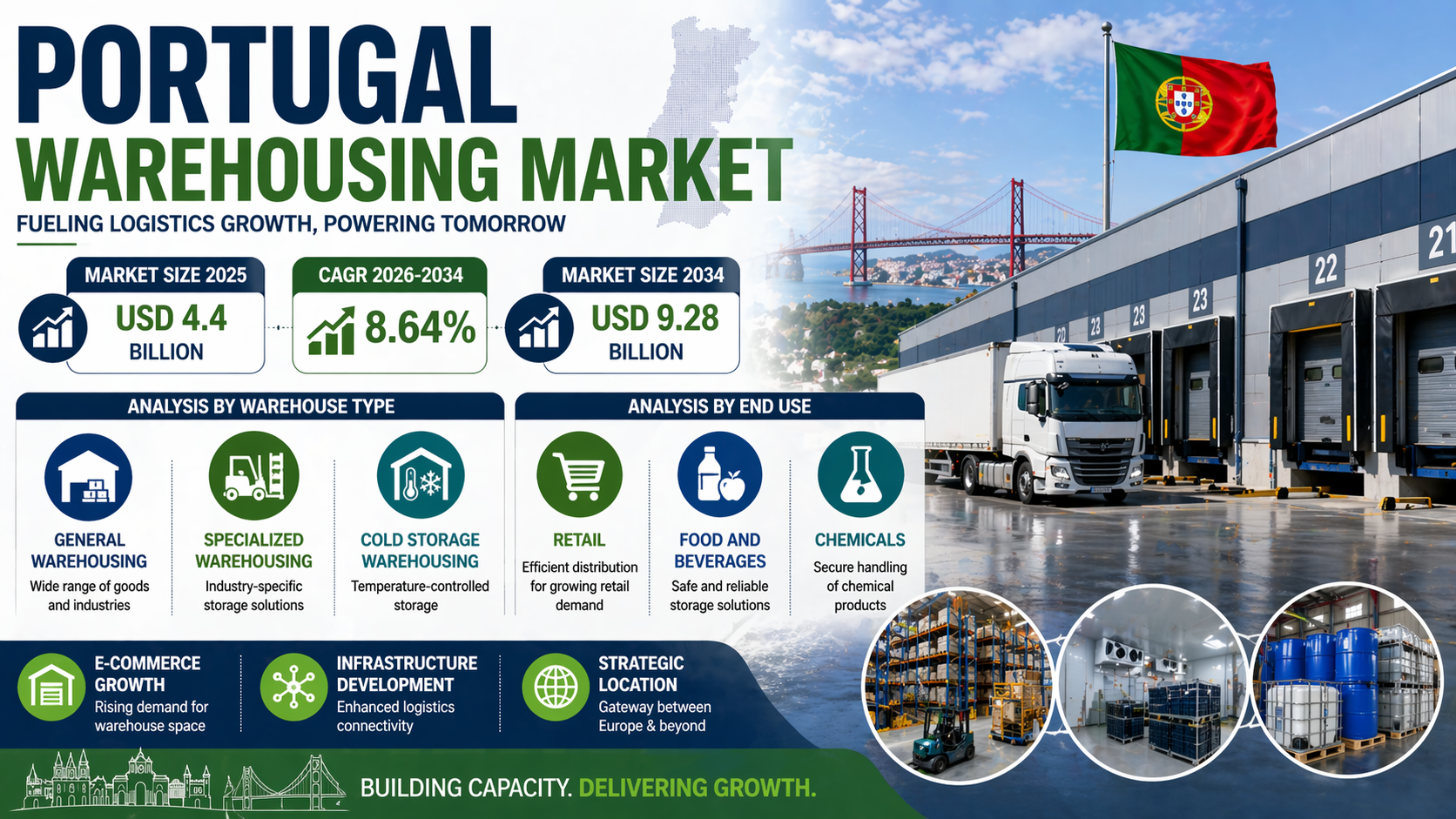
The Portugal warehousing market refers to the industrial sector and physical infrastructure dedicated to the storage, management, and distribution of goods within Portugal. This market involves various facility types – ranging from general ambient storage to specialized temperature-controlled environments – that act as critical nodes in the national and international supply chain. By providing a buffer between production and consumption, the Portugal warehousing market facilitates trade flows, supports e-commerce fulfillment, and ensures the efficient movement of inventory across domestic and European Union (EU) borders. In 2025, the market reached a valuation of USD 4.4 Billion, driven by its strategic geographic positioning as a gateway to Europe, Africa, and the Americas.
What is the Projected Size and Growth Rate of the Portugal Warehousing Market Through 2034?
The financial trajectory of the Portugal warehousing market indicates a period of sustained and rapid expansion. After reaching USD 4.4 Billion in 2025, the industry is forecasted to more than double in size, hitting a valuation of USD 9.28 Billion by 2034.
This growth is defined by a robust Compound Annual Growth Rate (CAGR) of 8.64% during the forecast period of 2026–2034. This momentum is fueled by a surge in e-commerce penetration, significant government spending on multimodal transport infrastructure, and a rising demand for high-tech, automated storage solutions that can handle high-velocity inventory turnover.
Market Outlook Summary
| Attribute | Details |
| Market Size (2025) | USD 4.4 Billion |
| Projected Size (2034) | USD 9.28 Billion |
| Growth Rate (CAGR) | 8.64% (2026-2034) |
| Key Drivers | E-commerce, Government Infrastructure, AI Integration |
How is the Rapid Expansion of E-commerce Driving Demand for Urban Distribution Centers?
The primary catalyst for Portugal warehousing market trends is the massive shift toward online retail. With the Portuguese e-commerce market reaching USD 74.24 Million in 2024, logistics providers are racing to secure space that supports same-day and next-day delivery expectations.
This shift is prompting the development of micro-fulfillment centers and “Last-Mile” distribution hubs located near major urban centers like Lisbon and Porto. To manage the high product turnover and complex return logistics associated with online shopping, companies are moving away from traditional “static” storage toward dynamic facilities equipped with automated conveyor systems and real-time inventory tracking.
Why are Government Infrastructure Investments Essential for Portugal’s Logistics Connectivity?
Public sector investment is a major engine for the Portugal warehousing market share. By modernizing the nation’s road, rail, and port facilities, the government is enhancing the country’s attractiveness as a regional distribution gateway.
A landmark development in October 2025 was the initiation of a €746 Million renovation of the national rail system. This bold project includes:
- High-Speed Connectivity: A new link between Lisbon and Porto reducing travel time from three hours to just over one.
- Port Expansion: Enhancing deep-water ports in Sines, Leixões, and Lisbon to support large-scale maritime trade.
- Multimodal Integration: Improving the flow of cargo between sea, rail, and road to reduce transit times and operational costs.
How is Artificial Intelligence (AI) Reshaping Modern Warehousing Operations in Portugal?
Artificial Intelligence is no longer a luxury but a core operational necessity in the Portugal warehousing market. AI-powered Warehouse Management Systems (WMS) are enabling intelligent automation that addresses labor shortages and boosts throughput.
Key AI applications include:
- Predictive Analytics: Forecasting demand patterns to optimize stock replenishment.
- Robotic Systems: Utilizing Machine Learning (ML) for complex picking, sorting, and packing with minimal human intervention.
- Route Optimization: Streamlining internal warehouse movements and external delivery paths.
- Cold Chain Robotics: Implementing robotic stacking technology in temperature-controlled environments to maintain precision and safety.
In May 2025, Noatum Logistics launched its first robot-assisted refrigerated warehouse in Lisbon, showcasing how AI-driven cold storage is meeting the demands of the West Mediterranean logistics corridor.
What Role Does Sustainability and ESG Compliance Play in Attracting Logistics Investors?
Sustainability has emerged as a competitive differentiator in the Portuguese market. Companies are increasingly seeking “green warehouses” to meet Environmental, Social, and Governance (ESG) commitments and align with EU climate directives.
Modern developers are prioritizing eco-efficient facilities featuring:
- Solar Rooftops: Generating renewable energy to power automation and cooling systems.
- EV-Compatible Loading Areas: Supporting the transition to electric delivery fleets.
- Advanced Insulation: Reducing the energy required for climate-controlled storage.
- Rainwater Harvesting: Lowering the environmental footprint of large-scale facilities.
Sample Request For Your Business
Which Warehouse Types and End-Use Segments are Dominating the Market?
The Portugal warehousing market is categorized to serve diverse industrial needs. Each segment plays a unique role in the national supply chain.
Market Segmentation Analysis
| Category | Primary Segments |
| Warehouse Type | General Warehousing, Specialized Warehousing, Cold Storage |
| End Use | Retail, Food and Beverages (F&B), Chemicals, Others |
| Geographic Hubs | A. M. Lisboa, Norte (Porto), Centro, Alentejo |
General Warehousing remains the largest segment by volume, but Cold Storage is seeing the fastest technological upgrades due to the rising needs of the pharmaceutical and fresh food sectors.
What are the Major Challenges Facing the Warehousing Sector in Portugal?
Despite strong growth, the industry must navigate several significant hurdles:
- Rising Costs: Land prices near strategic hubs like Setúbal and Lisbon have surged, while construction material and labor costs remain high.
- Labor Shortages: There is a critical gap in tech-skilled professionals capable of managing automated robotics and digital inventory systems.
- Infrastructure Bottlenecks: While improving, uneven connectivity between inland industrial zones and major ports can still create logistics delays.
These factors can restrict the expansion of storage capacity and push rental rates higher, challenging the cost-competitiveness of smaller logistics operators.
Which Recent Industry Developments are Impacting the Competitive Landscape?
Competition is intensifying as international logistics giants and regional providers expand their footprints. Notable recent milestones include:
- July 2025: Mercadona opened its Almeirim Logistics Block with a €290 Million investment. This facility is the company’s largest logistics center in the Iberian Peninsula, supporting 63 stores and creating over 600 jobs.
- May 2025: Noatum Logistics (part of AD Ports Group) inaugurated a high-tech refrigerated center in Lisbon to capitalize on multimodal transport links and growing demand in the Mediterranean.
Conclusion:
The Portugal warehousing market is undergoing a transformative era of modernization. With a projected valuation of USD 9.28 Billion by 2034, the sector is thriving on the back of e-commerce expansion, high-speed rail investments, and AI-driven automation. While challenges regarding land costs and labor skills persist, Portugal’s strategic role as a global transshipment hub and its shift toward sustainable, green warehousing ensure it will remain a vital pillar of the European logistics network for the next decade.