Cybersecurity is about keeping systems and networks from bad people who try to break in or hurt them. It helps keep information accurate and easy to get to. Cybersecurity does this with the help of things, like firewalls, encryption and antivirus software. To really be safe you need to have the tools follow the right steps and have people paying attention to what is going on with Cybersecurity. Cybersecurity is important because it helps keep information safe and sound.
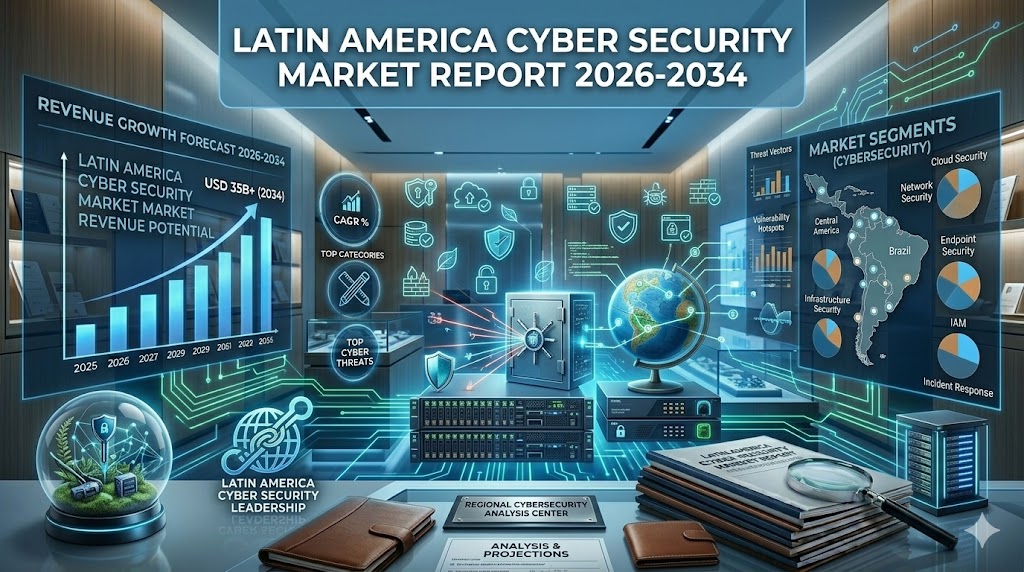
According to the latest industry insights from IMARC Group, the Latin America cyber security market was valued at USD 23.06 Billion in 2025. The market is projected to reach USD 41.03 Billion by 2034, growing at a compound annual growth rate (CAGR) of 6.61% during the forecast period of 2026-2034.
How Big is the Latin America Cyber Security Market and What is its Growth Forecast?
The Latin America cyber security market is witnessing a period of robust expansion as organizations prioritize digital resilience. Valued at USD 23.06 Billion in 2025, the market is fueled by the escalating frequency and sophistication of cyberattacks targeting the region.
The forecast for the next decade remains strongly positive. By 2034, the market is expected to reach a total valuation of USD 41.03 Billion. This growth is supported by a CAGR of 6.61%, driven by the mass migration to hybrid cloud environments and the continuous proliferation of mobile devices, which have significantly broadened the attack surface for malicious actors.
What are the Main Segments Driving the Cyber Security Industry in Latin America?
To understand the market’s trajectory, it is essential to analyze the specific components, security types, and deployment models that dominate the landscape.
Market Segmentation and Leading Shares (2025)
| Segment Category | Leading Segment | Market Share |
| Security Type | Network Security | 28.07% |
| Component | Solution | 62.09% |
| Deployment | Cloud-based | 65.10% |
| End User | Banking, Financial Services, and Insurance (BFSI) | 26.12% |
| Country | Brazil | 49.08% |
Why is Network Security the Dominant Security Type in the Region?
Network security holds the largest market share at 28.07%. This dominance is primarily due to the rising frequency of network-based threats, including Distributed Denial-of-Service (DDoS) attacks, malware propagation, and unauthorized access attempts.
Enterprises and government institutions are investing heavily in:
- Next-Generation Firewalls: Featuring deep packet inspection and application-aware filtering.
- Intrusion Detection Systems (IDS): To monitor and block sophisticated zero-day threats.
- Network Segmentation: Particularly in industrial sectors like mining and energy to safeguard sensitive control systems.
Sample Request For Your Business
How is Cloud-Based Deployment Reshaping Procurement Priorities?
The shift toward Cloud-based deployment is undeniable, representing 65.10% of the total market. As businesses migrate workloads to distributed hybrid environments, traditional perimeter tools are becoming insufficient.
Organizations are increasingly adopting Cloud-native security solutions that offer:
- Multi-cloud visibility: Managing security across different cloud providers from a single console.
- Policy-as-code: Automating security configurations to prevent human error.
- Secure Access Service Edge (SASE): Combining network security with wide-area networking to support remote workforces.
Why is the BFSI Sector Leading Cyber Security Expenditure?
The Banking, Financial Services, and Insurance (BFSI) sector represents the largest end-user segment with a 26.12% share. Financial institutions in Latin America are reportedly 300 times more likely to be targeted by cyberattacks than other businesses.
Key drivers in this segment include:
- Digital Banking Proliferation: The rapid expansion of mobile payments has created new targets for phishing and payment fraud.
- Fintech Growth: Newer neobanks are implementing advanced encryption, multi-factor authentication (MFA), and behavioral analytics.
- Regulatory Pressure: Central banks in Brazil and Mexico now mandate stringent risk management and periodic security audits.
Which Countries are the Primary Hubs for Cyber Security in Latin America?
Regional performance is heavily influenced by the economic size and regulatory maturity of specific nations:
- Brazil (49.08% Share): The undisputed leader, Brazil’s market is driven by the National Cybersecurity Strategy and the enforcement of the LGPD (General Data Protection Law). Major metropolitan areas like São Paulo are seeing massive investments in Secure Digital Infrastructure.
- Mexico: A key market focusing on protecting its expanding manufacturing and financial sectors.
- Chile and Colombia: Emerging hubs where new laws (such as Chile’s Law 21.459) are compelling organizations to implement comprehensive security protocols.
What Role Do AI and Zero Trust Architecture Play in Modern Defense?
Technological innovation is critical to staying ahead of sophisticated cybercriminals. Two major trends are currently defining the Latin America cyber security market:
- AI and Machine Learning Integration: Organizations are embedding AI into platforms to enable predictive analytics. This allows systems to identify and block threats in real-time before they compromise critical systems, significantly reducing the burden on security teams.
- Zero Trust Architecture: Moving away from traditional “perimeter” defenses, Zero Trust assumes no implicit trust. Every access request must be rigorously verified, a model increasingly adopted by government agencies to address cloud security gaps.
What are the Main Challenges and Restraints Facing the Market?
Despite the high growth, several factors restrain the full potential of the industry:
- Talent Shortages: There is a persistent lack of skilled cybersecurity professionals. Approximately 31% of smaller organizations report vacant security roles, which can lead to higher breach costs.
- Budget Constraints: For small and medium-sized enterprises (SMEs), the high implementation costs of advanced solutions and ongoing subscription fees remain a financial barrier.
- Infrastructure Gaps: Legacy system integration complexity often slows down the modernization of cybersecurity frameworks in certain sectors.
How Are Managed Security Services Addressing the Talent Gap?
To combat the shortage of internal expertise, demand for Managed Security Services (MSS) is accelerating. These providers offer:
- 24/7 Monitoring: Through localized Security Operations Centers (SOCs) in cities like São Paulo and Bogotá.
- Pay-as-you-go Models: Making enterprise-grade protection affordable for smaller businesses.
- Upskilling Programs: Helping to foster local talent pools through on-the-job training and international cooperation.
What is the Future Outlook for Cyber Security in Latin America Through 2034?
The future of the Latin America cyber security market is defined by resilience and innovation. With a projected value of USD 41.03 Billion by 2034, the region is set to become a more mature and secure digital economy.
The convergence of stringent data protection regulations, accelerated cloud adoption, and AI-driven threat detection will ensure that Latin American enterprises remain defended against the global rise in cybercrime. Public-private partnerships will continue to be vital in strengthening regional cyber maturity, ensuring that the digital transformation remains a safe and prosperous journey for all stakeholders. For more detailed insights, the full Latin America Cyber Security Market Report by IMARC Group provides a comprehensive 2026-2034 forecast.